

How Much Should You Pay Affiliates and Partners? The Top #1 Commission Strategy

Learn how to calculate profitable affiliate and partner commission rates using margins, customer value, partner contribution, and business model.
Affiliate and partner marketing has become a significant revenue channel. According to the Performance Marketing Association’s 2025 industry study, U.S. affiliate marketing spend increased 49.8% between 2021 and 2024, reaching $13.62 billion and generating $113 billion in ecommerce sales.
This guide explains how to set profitable partner commission rates using your margins, customer lifetime value, and business model. You will find best practices, real-life examples, and the best tool to manage your partner strategy.
TL;DR
- Start with your margins and customer lifetime value, then adjust rewards for each business model, partner contribution, and outcome.
- There is no universally “good” commission rate: begin with a base rate, and define clear eligibility and attribution rules.
- Siren helps you manage affiliate, referral, sales commission, royalty, revenue-share, and other incentive programs with different commission structures from one system.
What Is a Good Affiliate Commission Rate?
A good affiliate commission rate is high enough to make promotion worthwhile for the partner, but low enough to preserve the contribution profit your business needs from the resulting customer.
The difference is not necessarily generosity. It usually reflects different margins, customer economics, and partner contributions.
Use market benchmarks as a reality check after you calculate what your business can afford. A competitor rate can tell you whether your offer will look attractive. It cannot tell you whether that offer will be profitable for your company.
A practical starting point is:
- Calculate the maximum affordable reward from your unit economics.
- Compare that ceiling with relevant competing programs.
- Choose a simple base rate below the ceiling.
- Test it with a small group of partners.
- Increase rewards only when incremental performance justifies the cost.
Related read: Partner Relationship Management Full Guide
Commission Rate vs. Commission Model
A commission rate determines how much a partner earns. A commission model determines which event earns the reward and how the amount is calculated.
| Concept | What it defines | Key question | Example |
|---|---|---|---|
| Commission rate | How much the partner earns from a qualifying action | ”How much should we pay?“ | 15% of net revenue |
| Commission model | Which action earns a reward and how the commission is structured | ”When and how should we pay?” | Recurring commission on each subscription renewal |
For example, 15% is a rate. Paying 15% on the first purchase is a model. Paying 15% on every subscription payment for twelve months is a different model with a very different total cost.
Before choosing a percentage, decide whether you are rewarding a click, qualified lead, completed purchase, subscription, renewal, expansion, or another milestone.

How to Build a Profitable Partner Commission Strategy
1. Define the Outcome You Want the Partner to Create
Start with the business result, not the percentage.
Ask:
- What action should earn a reward?
- How much control does the partner have over that outcome?
- Does the event create revenue immediately?
- How often is the event rejected, refunded, or cancelled?
- Does the customer continue generating value afterward?
- Are other partners or internal teams contributing to the same result?
For example, an affiliate who sends a customer directly to checkout can reasonably be rewarded for the sale. An agency that introduces a qualified account but does not control the sales process may be better suited to a qualified-lead bounty, a closed-deal bonus, or a hybrid of both.
2. Calculate Your Maximum Affordable Commission
Your commission ceiling is the most you could pay for the rewarded outcome while still preserving the profit contribution your business requires.
A simple order-level formula is:
Maximum partner commission = Expected contribution margin before commission - Required contribution profit
To calculate expected contribution margin, begin with net revenue and subtract the variable costs associated with generating and fulfilling the transaction. Depending on the business, those costs may include:
- Cost of goods sold
- Payment processing
- Shipping subsidies and fulfillment
- Variable customer support or service delivery
- Discounts and coupons
- Expected returns, refunds, chargebacks, or cancellations
- Other acquisition costs attached to the same customer
Here is an example of an ecommerce order with the following economics:
Net order revenue: $100
Cost of goods and fulfillment: $45
Payment, support, and other variable costs: $10
Required contribution profit: $25
The expected contribution margin before partner commission is $45. After protecting $25 in required contribution profit, the theoretical commission ceiling is $20.
That does not mean you should automatically offer 20%. It means anything above $20 would push the transaction below the profit contribution you decided to protect. Your starting offer might be 10%, with additional bonuses reserved for incremental volume, high-margin products, or new customers.
If partners are rewarded before revenue is confirmed, translate the event into expected value. For a qualified lead, for example:
Expected lead value = Close rate x Expected contribution profit from a new customer
A qualified lead with a 20% close rate and $1,000 in expected contribution profit has an expected value of $200 before accounting for sales costs and risk. Your lead bounty must sit comfortably below that value.
3. Adjust the Strategy for Your Business Model
The same calculation applies across businesses, but the important inputs change.
- Ecommerce and physical products - Focus on gross margin, product mix, discounts, shipping, fulfillment, and return rates. A single store-wide percentage can overpay on low-margin items and under-incentivize strategic products. Product- or category-specific rates are often more sustainable.
- SaaS and subscription businesses - Focus on gross margin, activation, churn, expansion, customer lifetime value, and the acquisition payback window. A company may choose an upfront bounty, a recurring percentage, or a hybrid structure. Recurring commissions should have explicit rules for cancellations, upgrades, downgrades, renewals, and duration.
- Service businesses - Focus on qualification, sales-cycle length, close rate, delivery capacity, and deal profitability. Because the partner rarely controls the entire sale, a flat reward for an approved lead plus a larger closed-deal bonus may align incentives better than a percentage of contract value.
- Digital products, courses, and memberships - Higher gross margins may support higher commission percentages, but refunds, support, platform fees, and content-production costs still matter. If a creator owns the product, their royalty should be modeled separately from the affiliate commission earned by the person who promoted it.
- Marketplaces and platforms - Base rewards on the revenue the platform retains, not the total transaction value moving through the marketplace. Programs can reward seller activation, a first transaction, ongoing platform revenue, or other milestones that reflect the platform’s actual economics.
- Hybrid and multi-product businesses - Use separate rules when products, customer types, or channels have materially different margins and lifetime value. One global rate is easy to explain, but simplicity stops being useful when it systematically rewards the wrong outcomes.
4. Choose the Simplest Reward Structure That Matches the Economics
Once you know what the event is worth, choose the calculation method.
- Percentage commissions work when transaction values vary and margins remain reasonably consistent.
- Flat rewards work when the outcome has a stable value, such as an approved lead or activation.
- Recurring commissions work when customer value continues and the partner’s contribution justifies ongoing participation.
- Tiered commissions work when higher performance creates enough incremental value to fund a higher rate.
- Hybrid structures work when partners create value at several stages, such as an approved lead, a closed deal, and recurring revenue.
Complexity should earn its place. If two commission structures produce roughly the same partner behavior and business result, use the one partners can understand and your team can administer reliably.
Check more reward structure models ->
5. Decide Whether Different Partners Should Earn Different Rates
Paying every participant the same amount feels fair, but it can ignore how value is actually created.
Here are some examples of different commissions and rates according to the value:
- Publishers or affiliates that generate new customer sales
- Creators or influencers who also produce reusable content
- Customers making occasional referrals
- Agencies that qualify, advise, or implement
- Strategic partners that support the account after the introduction
- High-performing partners that deliver incremental volume
Document who qualifies for each rate, when a new rate begins, whether it applies retroactively, and what happens if a partner qualifies for several structures at the same time.
6. Protect Profitability With Clear Operating Rules
You also need to define which revenue qualifies, how commissions are calculated, and when they become payable.
This includes whether rewards are based on gross or net revenue and how discounts, taxes, shipping, store credit, renewals, and repeat purchases are treated.
Your policy should also explain how attribution works when partners use referral links or coupon codes, whether rewards from multiple programs can stack, and which rule takes priority when more than one program claims the same transaction.
7. Launch With a Base Rate and Improve It From Real Data
Your first commission rate is a hypothesis, so start with a base structure and only a few justified exceptions.
Evaluate activated partners, conversion rates, new versus existing customers, average order or contract value, net revenue, contribution margin, refunds, cancellations, retention, and repeat purchases.
Most importantly, measure commission costs against contribution profit so you can see whether the program is generating profitable incremental growth.
Three Commission Examples
Ecommerce Example
A store sells products with very different margins. Instead of paying 15% across the catalog, it offers:
- 8% on low-margin products
- 12% on the core catalog
- 18% on a new high-margin product
- A $250 quarterly bonus after 30 approved new-customer orders
The rates reflect product economics, while the bonus rewards incremental volume without permanently increasing every commission.
SaaS Example
A SaaS company charges $200 per month and wants to recover partner acquisition costs within six months. It compares:
- A $300 flat reward after the customer remains active for 60 days
- 20% recurring commission for the first twelve months
- A hybrid model with $100 at activation and 10% for twelve months
The correct choice depends on expected retention, gross margin, cash flow, and how much ongoing influence the partner has.
Service Business Example
A consulting company sells projects averaging $10,000, but its internal team controls discovery, scoping, and closing. It pays:
- $100 for an approved opportunity that meets qualification criteria
- $500 when the opportunity becomes a paying customer
- An additional bonus when the referred account exceeds a defined revenue milestone
This rewards the introduction without pretending the partner performed the entire sales and delivery process.
Should Every Partner Program Use the Same Commission Strategy?
No. The reward should match the contribution and economics of the relationship.
An ecommerce business might simultaneously run:
- A percentage commission for affiliates generating online purchases
- A fixed reward or store credit for customer referrals
- A royalty for a creator whose product is sold
- A revenue share for a strategic distribution partner
- A bonus for employees or sales representatives reaching a milestone
These rewards can apply to different events or even the same transaction when they recognize different sources of value. The important decision is whether the rewards are intentionally stacking or accidentally duplicating each other.
This is where commission strategy becomes broader than affiliate rate setting. You are designing a system that determines who created value, which rules apply, and how much each contribution is worth.
Manage Multiple Programs and Commission Structures With Siren
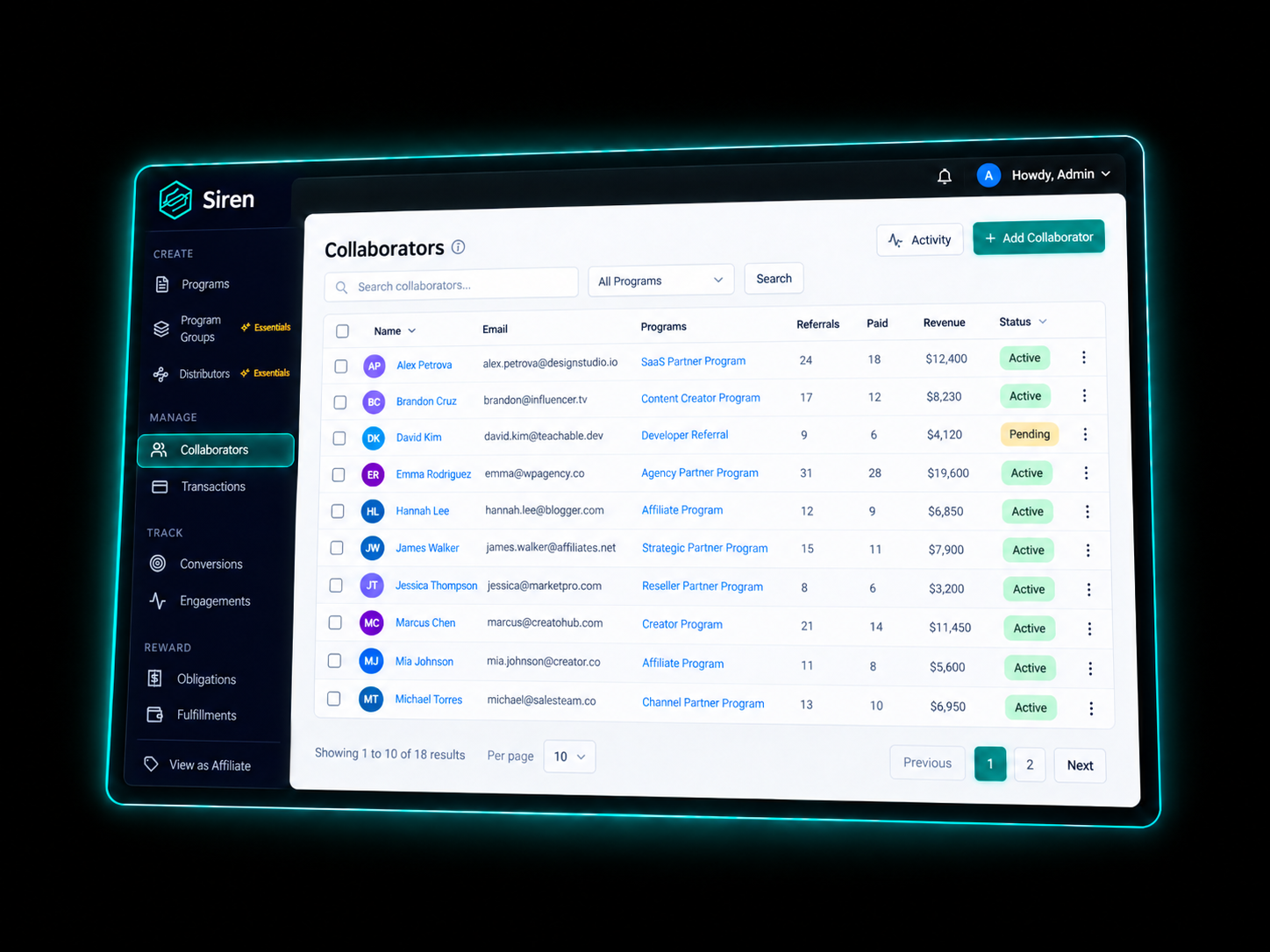
As your partnership strategy grows, a single commission structure rarely works for every relationship. The challenge of managing multiple partner programs starts.
Siren lets businesses translate their commission strategy into independent partner and incentive programs that operate through the same underlying system.
With Siren, you can:
- Create flat, percentage, recurring, tiered, bonus, revenue-share, and hybrid rewards
- Use different programs for affiliates, customers, creators, agencies, strategic partners, and sales teams
- Connect rewards to purchases, leads, subscriptions, renewals, milestones, or custom events
- Apply different economics by program, partner group, product, or qualifying condition
- Keep commissions pending until the approval requirements are met
- Track conversions, commissions, obligations, and fulfillments through one reward lifecycle
- Allow rewards to stack when they recognize distinct contributions
- Use Program Groups when overlapping programs should compete and only one should win
The objective is not to make every partner follow the same rate. It is to give every relationship the right rules without fragmenting partner data, reward calculations, and operational history across several systems.
Final Takeaway
Define the outcome you want. Calculate what that outcome is worth after variable costs and required profit. Adjust the reward for the business model, partner contribution, customer quality, and risk. Then add clear rules for attribution, refunds, renewals, approval, and overlapping incentives.
Competitor rates can help you understand the market, but they should never replace your own unit economics. The best commission is not the largest number on the recruitment page. It is the reward that attracts capable partners, changes behavior, and leaves enough value for the program to keep growing.
Frequently Asked Questions
What is a good affiliate commission rate?
A good affiliate commission rate is one that motivates partners while keeping the resulting customer or transaction profitable. The correct percentage depends on gross margin, customer value, refund risk, partner contribution, and the event being rewarded.
Is 10% a good affiliate commission rate?
It can be. Ten percent may be generous for a low-margin physical product and insufficient for a high-margin digital product. Evaluate the dollar amount a partner earns, the value of the customer, and the contribution profit remaining after the commission.
How do you calculate an affiliate commission rate?
Calculate the expected contribution margin from the rewarded outcome, subtract other acquisition costs and the minimum profit you need to retain, and use the remainder as the theoretical commission ceiling. Choose a starting rate below that ceiling and validate it with real program data.
Should different affiliates receive different commission rates?
Yes, when the difference reflects measurable value, economics, or performance. Different rates can be justified by product margin, new-customer acquisition, partner type, volume, customer quality, or additional responsibilities. The qualification rules should be transparent.
Should affiliate commission be based on gross or net sales?
Net sales are usually safer because they allow the program to exclude discounts, refunds, taxes, shipping, and other amounts that do not represent retained revenue. Whatever definition you choose should be documented clearly and applied consistently.
When should affiliate commissions be approved?
Approval should occur after the business can reasonably confirm that the rewarded outcome is valid. Ecommerce programs may wait until the return period closes, SaaS programs may require an activation or retention milestone, and lead programs may require manual qualification.
Can one sale generate more than one partner commission?
Yes, when different rewards recognize different contributions. An affiliate commission and a creator royalty, for example, can both apply to one order. When two programs reward the same contribution, use a priority rule so the sale is not paid twice.