

9 Affiliate Commission Models and How to Choose the Right One

Compare nine affiliate commission models and choose a flat referral fee or revenue share for channel partners.
What should an affiliate or partner get paid for: a click, a qualified lead, a completed sale, a recurring subscription, or a milestone?
The answer depends on the outcome they can influence and the point at which you can confidently assign credit. This guide compares nine common commission models, then applies that decision to channel partners such as distributors, POS vendors, and field techs.
What Is an Affiliate Commission Model?
An affiliate commission model defines the action that earns a reward and how that reward is calculated.
An affiliate might earn $50 for a qualified lead, 10% of a completed sale, or a recurring commission while a referred customer remains subscribed. The model tells partners which outcomes matter and gives the program a clear basis for credit and payment.
9 Types of Affiliate Commission Models
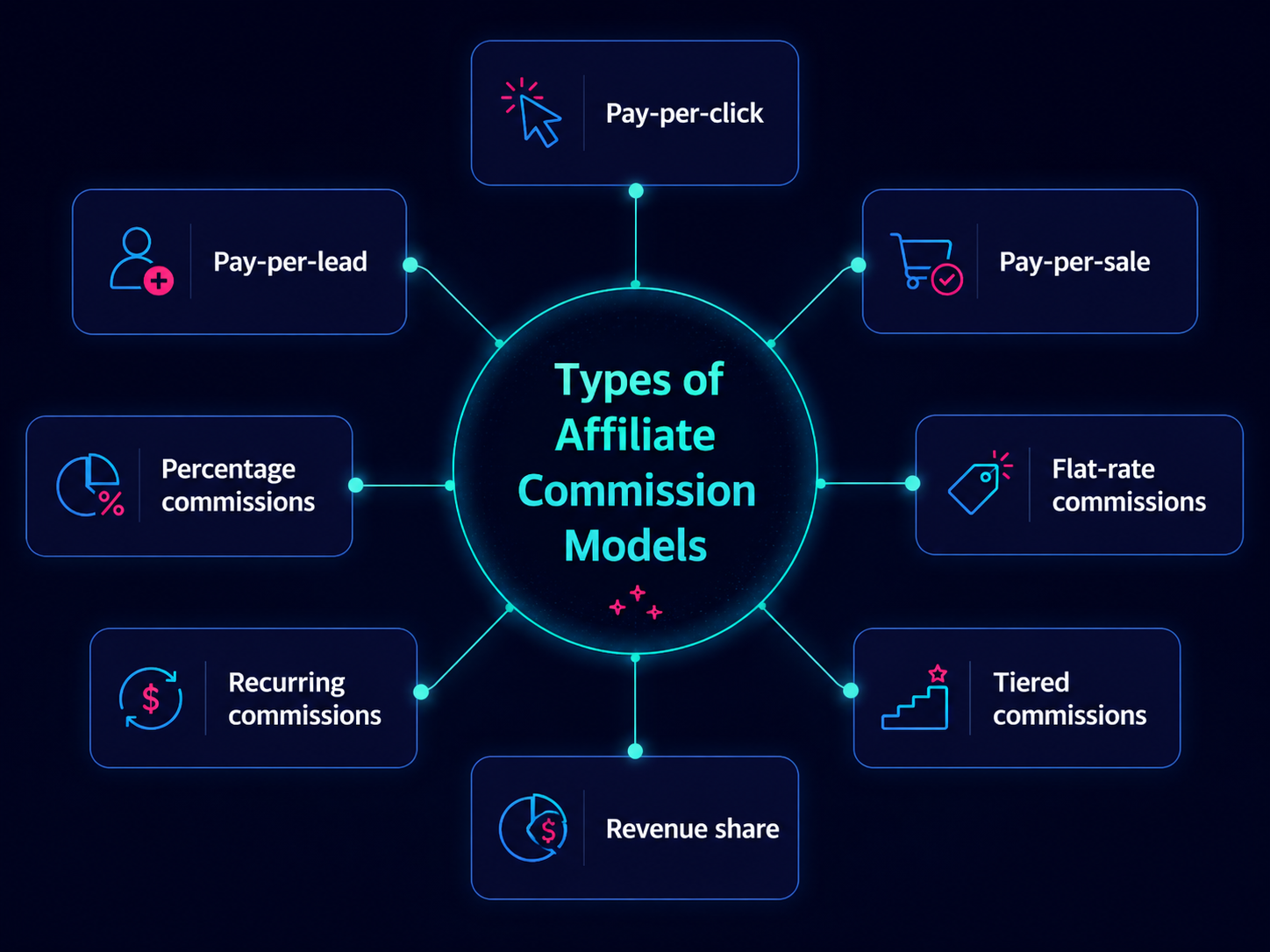
Affiliate programs can reward different actions and calculate commissions in different ways. The right model depends on the value a partner creates, who controls the next step in the customer journey, and how much of the outcome can be attributed to that partner.
Pay-Per-Click
In a pay-per-click model, affiliates earn when someone clicks their referral link. It can suit programs where reaching the right audience has value on its own, but clicks sit far from revenue.
Traffic quality, duplicate activity, and click fraud need close attention. A click can show how someone arrived; it does not, by itself, show that the visitor became a customer.
Pay-Per-Lead
In a pay-per-lead model, affiliates earn when a referred prospect completes a defined lead action, such as requesting a demo or signing up for a trial.
Define a qualified lead before setting the commission. Without qualification, validation, and approval rules, a program can pay for form volume instead of real opportunities.
Pay-Per-Sale
Pay-per-sale rewards an affiliate only after a referred customer completes a purchase. The reward may be a fixed amount or a percentage of the sale value.
This model suits journeys where an affiliate can move a customer directly from recommendation to checkout. It ties acquisition cost closely to revenue, but an affiliate may go unpaid when they influenced an earlier stage and the eventual sale is not attributed to them.
Flat-Rate Commissions
A flat-rate commission program pays a fixed amount for a defined action. It works when the outcome has a consistent value and both the business and affiliate need a predictable number.
A flat rate is especially useful when you want a clear acquisition cost. Before launching, decide which completed outcome earns the payment and how refunds or cancellations affect it.
Percentage Commissions
A percentage commission pays an affiliate a share of the value of a completed transaction. For example, an affiliate might earn 10% of every referred sale.
It scales with revenue when order values vary, so set the treatment for discounts, refunds, and unusually large transactions before launch. The percentage should leave room for the margin you need to protect.
Recurring Commissions
Recurring commissions continue while a referred customer remains active or continues paying. A program might, for example, pay 20% of subscription payments for 12 months.
This model can align rewards with long-term customer value. Its terms need to address churn, upgrades, downgrades, and the point at which commissions end.
Tiered Commissions
Tiered commissions change the rate when an affiliate reaches a performance threshold. An affiliate might earn 10% on early sales, 15% after a volume target, and 20% at a higher threshold.
Tiers can reward sustained performance, provided partners can easily understand how they move between rates. The threshold and the rate should be clear before promotion begins.
Revenue Share
Revenue share pays a defined portion of revenue generated by referred customers or accounts. It is useful when the relationship keeps producing value after the initial introduction.
Define eligible revenue, refunds, account changes, attribution, and the period in which the share applies. Those terms matter because the payment is tied to an ongoing customer relationship rather than one isolated transaction.
Hybrid Commission Models
Hybrid models combine two or more reward structures. A SaaS company might reward an approved lead, add a bonus when that account becomes a customer, then share subscription revenue for a defined period.
This can reflect a complex customer journey, but every rewarded event and payout condition must be clear enough for partners to understand how they earn.
Pay-Per-Lead vs Pay-Per-Sale
The difference is the event that triggers the reward. With pay-per-lead, the affiliate earns for generating a qualified prospect. With pay-per-sale, the affiliate earns after the referred customer completes a purchase.
| Pay-per-lead | Pay-per-sale | |
|---|---|---|
| Rewarded event | Qualified lead | Completed sale |
| Revenue guaranteed | No | Yes |
| Sales-team involvement | Usually higher | Usually lower |
| Qualification rules | Critical | Purchase confirms conversion |
| Affiliate conversion barrier | Lower | Higher |
If your sales team controls the weeks or months after a referral, rewarding a qualified lead may create the fairer incentive. If an affiliate can drive customers directly to purchase, pay-per-sale can keep commissions closely tied to revenue.
Flat Referral Fee vs Revenue Share for Channel Partners
A regional distributor, POS vendor, or independent field tech is not simply a publisher sending traffic. They may introduce you to a multi-location retailer, remain close to that account, and influence the relationship after the introduction. The decision is not which commission sounds more generous; it is which relationship you are paying for.
A link or code path attributes a click. A contract path attributes a customer.
A link or code can identify the path that brought someone to you. When a partner is credited for an ongoing account relationship, the agreement needs to establish who is entitled to that customer. A referred visit alone does not create a payable commission; payment follows a completed sale.
Choose a flat referral fee when an introduction is the partner’s discrete contribution and a fixed acquisition cost matters more than sharing future upside. In Siren’s B2B Referral Program, each completed referred sale earns the same fixed $50 commission regardless of sale size; a refunded sale cancels that obligation.
Choose ongoing revenue share when the customer relationship keeps producing value and the partner will continue to serve or influence the account. In Siren’s Partner Revenue Share Program, a partner can receive a percentage on purchases made by the customer bound to them, including a later renewal purchase.
The practical choice is straightforward: pay a flat fee when you are paying for a completed introduction, and use revenue share when you are sharing in continuing account value. The recipes explain how to configure the model after you have made that decision.
Worked Example: Melissa Love’s Affiliate Structure
In the Melissa Love podcast episode, Love describes a membership affiliate structure with a 30% standard commission and 40% for a small group of power affiliates. Attribution runs through affiliate links, each promotional cycle uses one single-use first-month-free code, and payout is held until the referred customer pays.
The example separates decisions that are often blurred together. Commission rate can vary by partner tier, while attribution and payout conditions determine when a partner has earned the commission. For channel partners, make the same separation: decide whether the relationship calls for a click-based referral reward or customer-based revenue share, then choose the terms that fit that decision.
How to Choose the Right Affiliate Commission Model
Start with the business outcome you want partners to create. Traffic, qualified leads, completed sales, recurring revenue, and milestones each justify a different model.
Next, ask who controls the rest of the customer journey. If your team takes over after the referral, pay-per-lead may fit. If the affiliate can drive customers directly to purchase, pay-per-sale may be more appropriate. Where value accumulates over time, recurring commissions, revenue share, tiers, or a hybrid can better reflect the relationship.
For distributors, vendors, and field techs, make one further decision: are you paying for an introduction or sharing the continuing value of an account? That answer determines whether a flat referral fee or revenue share is the clearer fit.
Which Affiliate Commission Model Fits Your Business?
The right model depends on where value is created in your customer journey and which actions partners can realistically influence.
Ecommerce Businesses
Pay-per-sale and percentage commissions are often a natural fit for ecommerce because affiliates can send customers directly to a product page or checkout. Tiers can reward affiliates who continue to produce valuable sales volume.
Ecommerce programs can also use product-specific bonuses or thresholds when particular orders matter more to the business. The commission structure should remain simple enough for affiliates to explain to their audiences.
B2B SaaS Companies
Pay-per-lead or hybrid models can make more sense for B2B SaaS with longer, sales-led buying journeys. An affiliate or partner might generate a qualified demo request while the internal sales team manages discovery, follow-up, and closing.
When customer value continues after the sale, recurring commissions or revenue share may better match the contribution the partner makes. The key is to distinguish the introduction from the customer relationship and set credit accordingly.
Service Businesses
Pay-per-lead is often practical for service businesses because the final sale may follow a consultation, quote, or extended evaluation. Clear qualification criteria help ensure the program rewards genuine opportunities rather than every form submission.
A fixed payment can also work when the business has a predictable value for a completed appointment, qualified consultation, or sale. Choose the event that reflects the value the partner can truly influence.
Marketplaces and Platforms
Revenue share can fit marketplaces and platforms where referred users continue generating value through transactions or account activity. The agreement should define eligible revenue and how long the share continues.
A hybrid structure can reward an important early milestone while still sharing value over time. Avoid adding events simply because they can be measured; each reward should correspond to a meaningful contribution.
How Siren Helps You Build Commission Rules
Siren can support distinct commission structures for affiliates and partners. Its recipes illustrate a fixed $50 commission on completed referred sales, revenue share on purchases made by a customer bound to a partner, and tiered rates for different affiliate groups.
The right configuration follows the decision, not the other way around. Use the flat-fee or revenue-share recipe once you have chosen how the partner should earn, then define the program terms your business needs.
For more ideas on shaping referral incentives, see Referral Program Ideas. You can also try Siren’s interactive demo to explore the product.
Final Takeaway
Choose the commission model that matches the value a partner creates and the point at which you can assign credit.
For affiliates driving a direct purchase, pay-per-sale may be enough. For sales-led programs, a qualified lead or hybrid structure can better reflect the journey. For channel partners, the decisive question is whether you are paying for a single introduction or sharing the continuing value of an account.