

Partner Relationship Management: The Ultimate Guide for 2026

Learn how partner relationship management works, how to track and reward partner contributions, and how to choose the right PRM software.
Partner relationship management, or PRM, is the process of managing the people and organizations that contribute to your growth. It connects partner relationships with the systems, workflows, attribution rules, and incentives needed to run those relationships at scale.
In this guide, we’ll break down how partner relationship management works, the different types of partners businesses manage today, and the four core components of a partner program: manage, track, attribute, and reward.
What Is Partner Relationship Management?
Partner relationship management (PRM) is the process of managing the people and organizations that help a business generate leads, influence sales, bring in customers, or contribute to revenue.
It includes the systems and workflows used to manage partners, track their activity, attribute outcomes, and reward them based on the value they create.
The Impact of Partner Relationship Management in 2026
Partner-driven growth is becoming a bigger part of how businesses generate and influence revenue:
- In 2025, 75% of all global B2B transactions will flow through channel partners - resellers, distributors, affiliates, and other third parties - Continu
- 65% of partnership leaders report more than 20% YoY growth in partnership revenue. - Ecosystem Compass Report, 2025
- The channel ecosystem software market is forecast to grow from $7.46 billion in 2024 to $13.48 billion by 2028. - Omdia
The Different Types of Partner Programs
Partner programs can take different shapes depending on who contributes to growth, what they contribute, and how the business wants to reward them.
Common program types include:
- Affiliate programs: Pay partners a commission for the sales or conversions they refer.
- Referral programs: Reward customers or partners for introducing new leads or customers.
- Revenue share and royalty programs: Share revenue with creators, vendors, and business partners based on the value they help generate.
- Loyalty and rewards programs: Give customers credit or rewards for purchases and other valuable actions.
- Sales commission programs: Incentivize sales reps, teams, and channel partners with commissions, bonuses, or split credit.
The program shape may change, but the core challenge remains the same: track who contributed, attribute the right outcome, and reward them according to the rules of the program.
The Four Core Components of Partner Relationship Management
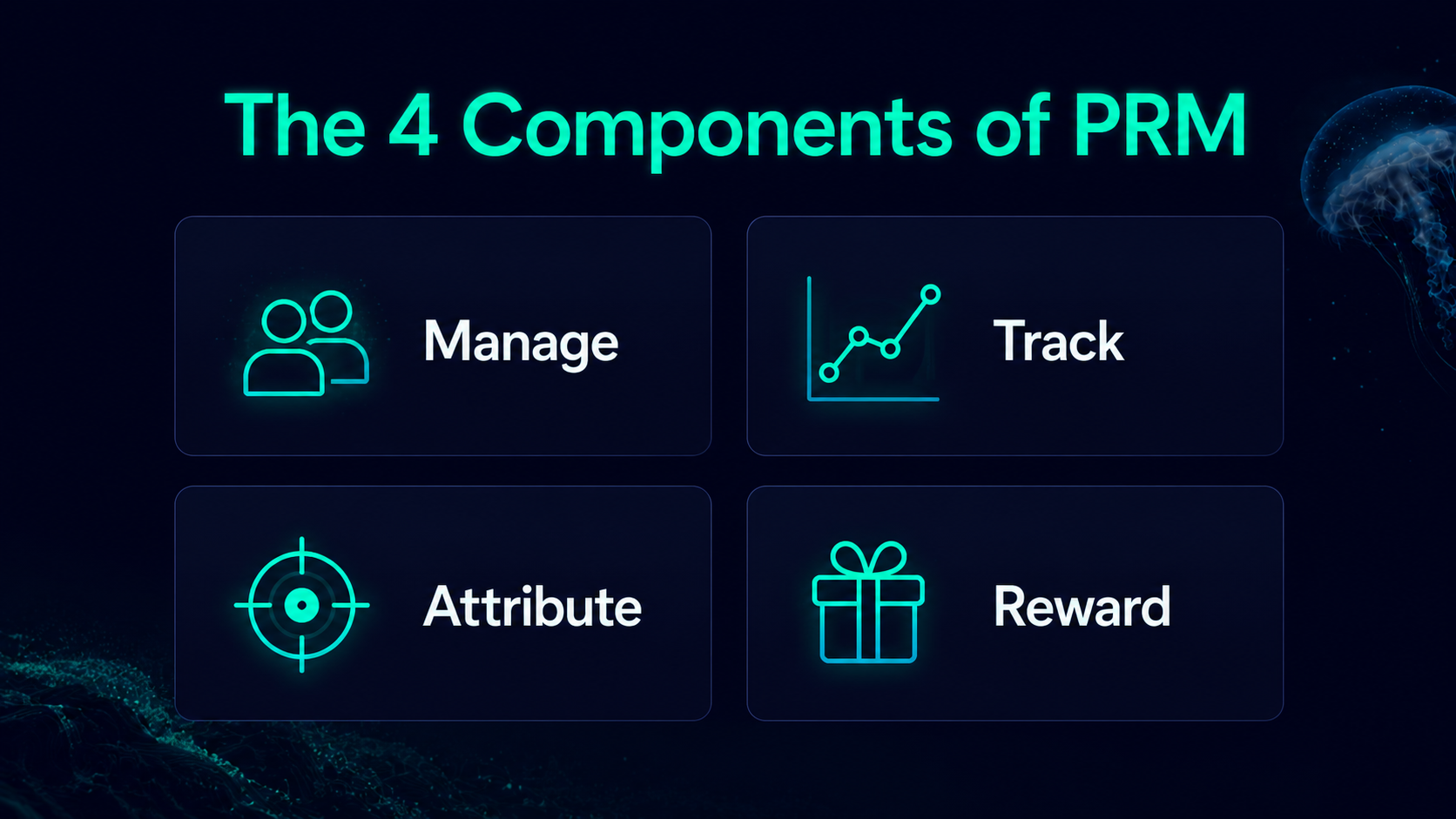
Effective partner relationship management comes down to four core functions: manage, track, attribute, and reward.
- Manage: Organize your partners, define their role in the program, and give them the structure they need to participate.
- Track: Capture the actions and events partners generate, from clicks and leads to sales and recurring revenue.
- Attribute: Connect each measurable outcome to the partner, or partners, who contributed to it.
- Reward: Apply the program’s rules to calculate commissions, credits, bonuses, revenue share, or other incentives.
Together, these four components turn a collection of partner relationships into a program that can be measured, managed, and scaled.
Partner Relationship Management vs CRM
Customer relationship management (CRM) focuses on managing customer relationships and tracking their journey through the sales process. Partner relationship management focuses on the people and organizations that help create or influence those customer outcomes.
The two systems work together. A CRM may record a new lead or sale, while PRM helps identify which partner contributed to that outcome, how credit should be assigned, and whether a reward or commission was earned.
Partner Programs vs Affiliate Programs
An affiliate program is a type of partner program, typically built around a straightforward model: an affiliate promotes a business, drives a tracked conversion, and earns a commission.
Broader partner programs can reward many other types of contributions, including qualified leads, introductions, influenced deals, recurring revenue, or shared sales efforts. The difference is not simply who the partner is, but what contribution the program needs to track and reward.
| Affiliate Programs | Partner Programs | |
|---|---|---|
| Who participates | Affiliates and publishers | Affiliates, agencies, creators, referrers, and strategic partners |
| Typical contribution | Tracked promotion and conversions | Leads, introductions, influenced deals, sales, or revenue |
| Attribution | Often link or coupon-based | Can use multiple contribution and attribution models |
| Rewards | Usually commission per conversion | Commissions, flat rewards, bonuses, revenue share, or credits |
| Program scope | One specific partner model | Broader range of partner relationships |
Benefits and Challenges of Partner Relationship Management
Partner relationship management can make partner-driven growth easier to measure and scale, but it also requires clear program rules, reliable data, and the right workflows.
| Benefits | Challenges |
|---|---|
| Better visibility into partner contributions | More complex attribution |
| Clearer commission and reward rules | Inconsistent or fragmented data |
| More scalable partner operations | Managing different partner types |
| Stronger partner incentives | Preventing errors and reward disputes |
| Better partner performance insights | Choosing and maintaining the right systems |
Benefits of Partner Relationship Management
A structured PRM approach helps businesses understand which partners are contributing to growth, apply consistent attribution and reward rules, and identify opportunities to improve partner performance.
It can also reduce manual program management and give partners clearer expectations around what they need to do, how their contribution is measured, and what they can earn.
Common PRM Challenges
Partner programs become harder to manage when different partners generate different outcomes or contribute at multiple points in the customer journey.
Poor tracking, unclear attribution rules, fragmented systems, and overly complex incentive structures can create inaccurate commissions and partner disputes. The goal of PRM is not to add more process, but to create clear rules around contribution, credit, and rewards.
How Partner Attribution Works
Partner attribution is the process of connecting a measurable outcome to the partner, or partners, who contributed to it. That outcome may be a lead, introduction, sale, subscription, or another event defined by the partner program.
The basic flow is simple: a partner contributes, the business tracks an attributable event, attribution rules assign credit, and the program determines the reward. The tracked signal may come from a referral link, coupon code, form submission, CRM event, or server-side conversion.
Not Every Partner Journey Has a Single Touchpoint
Real partner journeys can involve more than one contributor. One partner may introduce the customer, while another contributes closer to the final conversion.
Attribution models can assign credit to the first or last contributor, reward the strongest contribution, or split credit across multiple partners. The right model depends on which partner behavior the program is designed to recognize and reward.
How AI Is Changing Partner Attribution
Clicks are still useful, but they should not always be treated as the only attribution signal. AI-assisted discovery and purchasing can remove browser events from parts of the customer journey, making click-only attribution less reliable in some channels.
Modern partner programs may need to connect partner identity to other measurable signals, such as coupon codes, dedicated content, landing pages, form submissions, products, or server-side events. Learn more about affiliate attribution in the age of AI agents.
Partner Incentives and Reward Models
Partner incentives define what a partner earns when they create a valuable outcome. The right reward model depends on what the program is designed to generate, whether that is a sale, qualified lead, recurring revenue, introduction, or another measurable contribution.
Common partner reward models include:
- Pay per sale: A percentage or flat commission for each completed sale.
- Pay per lead: A fixed reward for generating a qualified lead.
- Revenue share: A percentage of the revenue connected to the partner’s contribution.
- Recurring commissions: Ongoing rewards tied to subscription or repeat revenue.
- Flat-fee rewards: A fixed amount for a specific action or outcome.
- Tiered incentives: Higher rewards as partners reach defined performance levels.
- Performance bonuses and SPIFFs: Additional incentives for hitting specific goals or promoting priority offers.
- Non-cash rewards: Credits, products, points, access, or other benefits.
The most important question is not simply how much should partners be paid? It is which behavior or outcome are you trying to encourage? Once that is clear, the reward structure can be designed around it.
Best Partner Relationship Management Software
The best PRM software depends on the type of partners you manage and the workflows your program needs to support. Some platforms focus on traditional channel enablement, while others specialize in partner recruitment, deal management, or incentive and outcome tracking.
Here are five partner relationship management platforms to consider:
- Siren: Best for flexible partner incentives, attribution, commissions, revenue share, and programs that reward different measurable outcomes.
- Impartner: Best for large channel ecosystems that need partner onboarding, training, deal registration, lead management, and partner enablement.
- PartnerStack: Best for B2B SaaS companies looking to recruit and manage affiliate, referral, and co-sell partners through a broader partner ecosystem.
- Channeltivity: Best for technology companies managing traditional channel sales programs, including deal registration, lead distribution, partner portals, and enablement.
- Kiflo: Best for B2B partner teams that need lead and deal tracking, partner visibility, onboarding, and centralized partner collaboration.
There is no single best PRM platform for every partner program. The right choice depends on whether your biggest challenge is enabling partners, recruiting them, managing deals, or tracking and rewarding the outcomes they create.
How to Choose Partner Relationship Management Software
The right PRM software depends on how your partners contribute to growth and which parts of the relationship are hardest to manage.
Before comparing platforms, consider these five questions:
1. What Types of Partners Do You Manage?
Affiliate partners, agencies, resellers, creators, referral partners, and strategic partners may need very different workflows. Choose software that fits the relationships you actually manage.
2. What Partner Contributions Do You Need to Track?
Define the outcomes that matter to your program, such as leads, introductions, sales, influenced deals, subscriptions, or recurring revenue.
3. How Should Partner Attribution Work?
Consider whether a single partner receives credit for an outcome or whether multiple contributors may need first-touch, last-touch, or shared attribution.
4. How Do You Want to Reward Partners?
Look for a platform that supports the incentive models your program needs, including flat rewards, commissions, recurring payouts, revenue share, bonuses, or custom reward rules.
5. Do You Need Partner Enablement or Incentive Management?
Traditional PRM platforms may be a better fit for certifications, training, content distribution, and deal registration. If your main challenge is tracking partner outcomes, assigning credit, and applying flexible reward logic, partner incentive management may be the more important capability.
The best PRM platform is not the one with the longest feature list. It is the one that can accurately reflect how your partners create value and how your business wants to recognize it.
How to Build a Partner Program With Siren for Free
You do not need to invest in a complex PRM stack before proving that your partner program works. With Siren Lite, you can start with a real program on your WordPress site for free and upgrade as your partner workflows become more advanced.
1. Choose the Outcome You Want Partners to Create
Start by defining what success looks like. Do you want partners to generate sales, introduce customers, contribute to recurring revenue, or drive another measurable action?
The outcome should determine how the program tracks contribution and rewards partners.
2. Start With a Prebuilt Program Recipe
Browse Siren’s program recipes and choose a structure that matches your goal. Recipes provide a ready-made program configuration that you can apply and adapt instead of building every rule from scratch.
3. Add Your Partners and Define the Reward
Enroll the people or businesses participating in the program and decide what they earn when they create the desired outcome.
Depending on the program, this may be a percentage commission, flat reward, recurring commission, revenue share, or another incentive structure.
4. Track Real Outcomes and Prove the Program
Run the program on your real WordPress site and track the contributions and conversions your partners generate.
Siren Lite is free with unlimited programs, affiliates, and conversions, so you can prove the model before paying for more advanced attribution, partner management, or reward workflows.
Start your first partner program for free with Siren.
Final Takeaways
Partner relationship management is no longer only about maintaining a partner directory or supporting traditional channel sales.
Businesses now work with affiliates, referral partners, agencies, creators, strategic partners, and other contributors who can influence growth in very different ways.
The challenge is understanding what each partner contributed, how that contribution should be attributed, and what they should earn as a result.
That is why effective partner relationship management comes down to four core functions: manage, track, attribute, and reward.
When those pieces work together, partner programs become easier to measure, improve, and scale.
And with a flexible system like Siren, businesses can build partner programs around the outcomes they actually want to create instead of forcing every relationship into the same commission model.