

7 Tips to Manage Multiple Partner Programs and Grow Faster

Learn how to manage affiliate, referral, loyalty, royalty, and sales incentive programs in one system—without duplicate payouts or scattered data.
Running one partner program is relatively easy nowadays. You can manage it in a spreadsheet or, with some technical knowledge, build a more robust workflow with Claude.
But two problems quickly emerge:
- Relying on a single partner program—such as referrals or customer rewards—limits the partner types and behaviors you can incentivize, which can also limit its impact on sales and lead generation.
- As soon as you add more programs, each comes with its own partners, rewards, rules, and payout processes. In many cases, that also means adding another tool.
Why You Need Multiple Partner Programs to Move the Needle
Adding programs only creates value when each one activates a different partner type, behavior, or stage of the customer journey. The clearest benefits are:
- Reach more markets and buying contexts. Salesforce’s latest State of Sales data shows that 94% of sales teams use partner selling, up from 86% in the previous edition, and 90% use dedicated partner tools.
- Turn existing trust into more opportunities. Nielsen’s Trust in Advertising research found that 88% of global respondents trust recommendations from people they know more than any other marketing channel.
- Support acquisition and retention at the same time. A Forrester Consulting study of 454 companies found that partnership programs can support both ends of the customer lifecycle. Affiliate, referral, and reseller programs can acquire customers, while loyalty, renewal, royalty, and revenue-share programs keep customers and collaborators invested.
- Build a more meaningful revenue channel. The same Forrester study found that partnerships contributed 28% of total revenue at high-maturity companies versus 18% at low-maturity companies, while partnership-channel revenue grew 28% versus 12%.

Best Practices to Manage Multiple Partner Programs at a Glance
Here are the seven best practices for keeping multiple partner and incentive programs clear, scalable, and connected:
- Give every program one clear job — Define the outcome, participants, qualifying action, reward, and success metric before launch.
- Centralize partner records, but segment participation — Keep one source of truth while enrolling each collaborator only in the programs relevant to them.
- Decide when rewards should stack—and when only one should win — Stack rewards for distinct contributions; use Program Groups when incentives overlap.
- Match incentives to the value partners create — Reward the event that matters, whether it is a sale, lead, renewal, course completion, or custom action.
- Standardize the launch process, not the program design — Use a repeatable brief, pilot, and templates while adapting the actual rules to each relationship.
- Automate the full reward lifecycle, not just tracking — Connect engagements, conversions, commissions, obligations, approvals, and fulfillments.
- Measure the portfolio, then improve each program — Compare shared growth metrics while retaining the KPIs that make each program distinct.
7 Best Practices for Managing Multiple Partner Programs
1. Give Every Program One Clear Job
Start by defining the business outcome: sales, retention, brand reach?
For every program, define five things:
- Who participates
- Which action qualifies
- How credit is assigned
- What reward is created
- Which business metric determines whether the program is working
This prevents two common mistakes: creating several programs that reward the same behavior without meaning to, and squeezing different partner relationships into one generic commission plan.
For example, an online store could run a 10% affiliate program for publishers, a fixed referral reward for customers, and a revenue-share program for business partners. They all support growth, but each has a different job and should remain independently configurable.
2. Centralize Partner Records, but Segment Participation
Each partner needs different incentives and communications. We recommend segmenting partners by factors such as type, maturity, geography, and vertical rather than applying one model to the entire ecosystem.
With Siren, the same collaborator can participate in several programs. For example, a creator can earn a royalty because they own the product and an affiliate commission when they personally refer the buyer.
This structure gives you a unified history of the relationship without flattening it. Your team can see who the collaborator is, which programs they belong to, and what they earned.
It also makes expansion easier. When an existing partner qualifies for a new initiative, you enroll them in the appropriate program instead of creating a duplicate account and another reporting trail.
3. Decide When Rewards Should Stack—and When Only One Should Win
This is the most important rule in multi-program management.
Suppose an affiliate promotes an online course created by an instructor. The affiliate generated the sale, while the instructor created the product. Paying an affiliate commission and an instructor royalty is intentional: two different contributions created value.
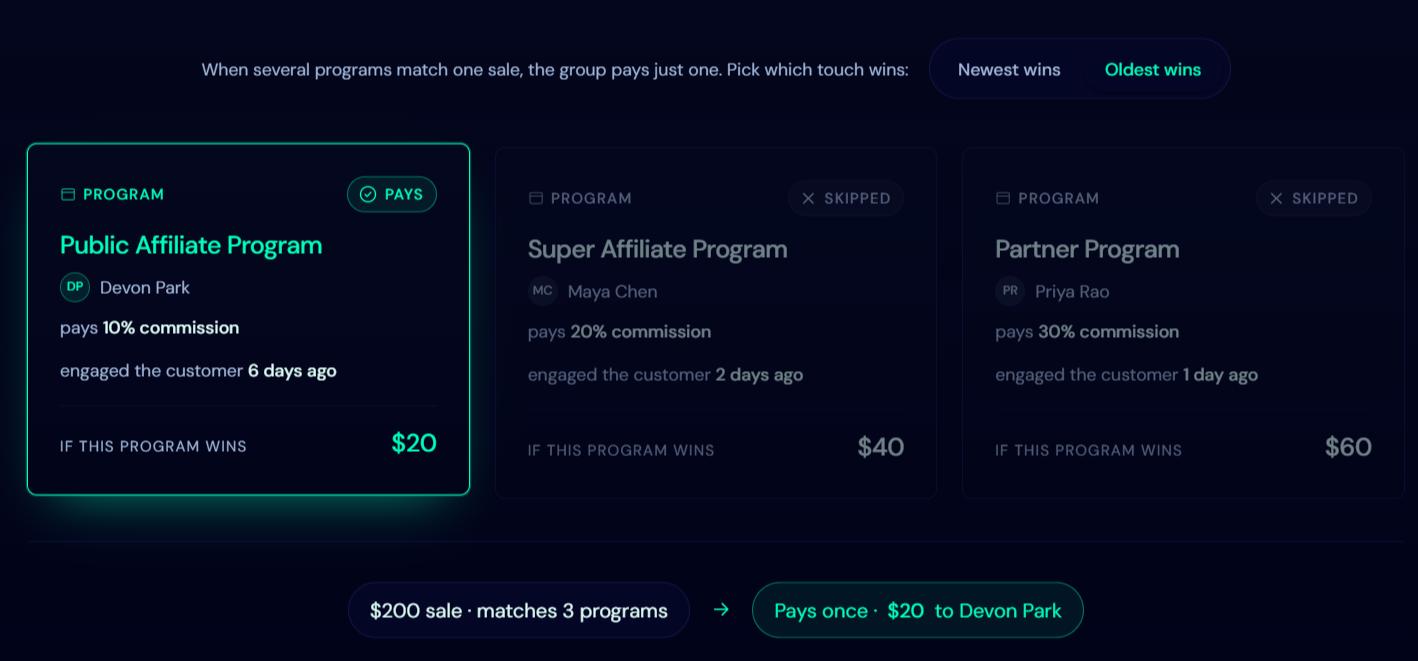
Siren solves that conflict. A Program Group bundles overlapping programs and applies a priority rule so only one program wins for a conversion. This is useful for:
- Standard and VIP commission tiers
- Regional rate variations
- Seasonal offers that temporarily replace a base program
- Multiple affiliate programs competing for the same sale
- Lead-generation and sales programs that should not both claim the same outcome
4. Match Incentives to the Value Partners Actually Create
It’s recommended to align incentives with the full partner journey, including both transactional and non-transactional contributions. The practical implication is that your platform must begin with the qualifying event—not with a fixed idea of what an “affiliate” does.
Siren uses a consistent event-to-credit-to-reward model across programs. Each program can listen for the action that matters, determine who deserves credit, and calculate the resulting obligation.
Depending on the program and integration, that action can be:
- A WooCommerce order
- A form submission
- A subscription renewal
- A course or lesson completion
- A sale involving a creator-owned product
- A custom event delivered through an integration or API
From there, each program can apply its own percentage, flat amount, recurring commission, filter, attribution window, or other configured calculation rule.
5. Standardize the Launch Process
Create a repeatable launch process that covers the essentials: goal, participants, qualifying action, attribution, reward calculation, rules, and success metrics. Then customize the configuration to the specific relationship.
Siren Recipes speed up this process by providing ready-made configurations for common program models.
A recipe gives you a working starting point, not a rigid template. You can preview the structure and adapt its rules, rates, participants, and calculations to your business. This makes the repeatable parts repeatable while keeping the program-specific decisions flexible.
6. Automate the Full Reward Lifecycle.
After a qualifying action, someone still needs to review it, account for cancellations or refunds, approve the reward, track what is owed, and record fulfillment. When each program handles that lifecycle differently, the team spends more time reconciling systems than improving partner performance.
You need a tool that keeps the lifecycle connected:
- Engagements record meaningful partner activity.
- Conversions record the qualifying outcomes generated by a program.
- Commissions calculate the reward associated with each conversion.
- Obligations show the running amount owed to each collaborator.
- Fulfillments record what has been paid or delivered.
- Activity feeds preserve a chronological audit trail across the major records.
Related Read: 7 Best Partner Relationship Management Software for 2026
7. Measure the Program Portfolio and Improve Each Program
Managing multiple programs gives you a portfolio of growth channels. Measure it like one.
These are a common set of metrics you can track:
- Activated partners, not just enrolled partners
- Qualified leads or conversions by program
- Revenue generated or influenced
- Approved rewards as a percentage of generated value
- Time from conversion to approval and fulfillment
- Refund, rejection, or reversal rate
- Performance by partner segment, product, and acquisition source
Review the portfolio regularly and make better decisions, like increasing incentives where incremental performance justifies the cost or retiring programs that duplicate another initiative.
What Multiple Programs Look Like in Practice
Let’s take an example of a B2B SaaS company that grows through affiliates, customers, employees, strategic partners, and its sales team. Each relationship contributes at a different point in the customer journey, so forcing everyone into one commission plan would create the wrong incentives.
With Siren, the company could run all of these programs through one incentive engine while keeping each program’s participants, attribution, and reward logic separate:
- Affiliate program — Reward publishers, creators, and niche experts when their traffic becomes a paying customer.
- Customer referral program — Reward customers when someone they introduce becomes a qualified lead, starts a trial, subscribes, or reaches another valuable milestone.
- B2B partner and agency referral program — Give agencies, consultants, implementation partners, or integration partners their own rules instead of forcing them into public affiliate economics.
- Employee referral program — Reward employees for qualified leads, customer introductions, or new partner introductions.
- Sales commission program — Compensate sales reps or account owners for new business, shared credit, renewals, or expansion revenue.
- Revenue-share program — Share recurring revenue with strategic or implementation partners whose contribution continues after the initial introduction.
- Performance bonus program — Add milestone, volume, expansion, launch, or partner-tier incentives on top of the base reward.
See how Siren supports SaaS and B2B partner programs.
When One Platform Is—and Is Not—Enough
As partnership channels mature, it creates opportunities to launch new programs and find new partners.
Today, many companies handle this by buying a different tool for each need. There is nothing inherently wrong with that approach, but the complications begin when several tools need to interpret the same customer journey, transaction, or partner relationship.
Without a platform that can coordinate multiple programs, your team can face:
- Fragmented partner data — The same person or company may exist in several systems, each with a different profile, status, or payment history.
- Conflicting attribution — Two tools may credit different partners for the same lead, sale, renewal, or expansion.
- Duplicate or overlapping rewards — Teams can accidentally pay twice for one contribution—or block valid rewards that should stack.
- Manual reconciliation — Operations and finance must compare exports, resolve discrepancies, approve rewards, and track payouts across separate workflows.
- Inconsistent partner experiences — Partners may need multiple portals, reports, onboarding processes, and sets of program terms.
- Incomplete reporting — Each platform shows the performance of its own program, but no system provides a reliable view of the entire partnership portfolio.
This is why you need a shared layer that determines who receives credit, which rules apply, whether rewards stack or compete, what is owed, and what has already been fulfilled.
Siren is designed to provide that incentive layer. Each program keeps its own participants, qualifying events, attribution rules, reward calculations, and approval logic, while collaborator records, conversions, obligations, fulfillments, and activity remain connected.
Build the Next Program Without Adding Another Platform
Managing multiple partner programs is about building a clear system in which each program has a specific purpose, rewards the right contribution, and can grow without creating unnecessary operational complexity.
The best practices covered in this guide work together: give every program one clear job; centralize partner records while segmenting participation; decide when rewards should stack and when only one should win; match incentives to the value created; standardize the launch process; automate the full reward lifecycle; and measure the entire portfolio from shared data.
Following these principles makes it easier to add affiliates, customer advocates, agencies, strategic partners, creators, or sales teams without losing control of attribution, program rules, approvals, and payouts.
You may still rely on specialized tools for CRM, billing, ecommerce, learning, communication, or payment execution. The goal is not to replace your entire stack. It is to avoid adding another disconnected incentive engine every time you introduce a new partner strategy.
Frequently Asked Questions
What is multi-program partner management?
Multi-program partner management is the practice of operating several partner or incentive programs through shared infrastructure while maintaining separate participants, qualifying actions, attribution rules, rewards, and performance metrics for each program.
Can one sale trigger more than one partner reward?
Yes. One transaction can include several distinct contributions. For example, Siren can create an affiliate commission for the person who referred a sale and a royalty for the creator who owns the product. Multiple rewards should stack when they compensate different sources of value.
How do you prevent duplicate commissions across programs?
First, identify programs that reward the same contribution. In Siren, you can place overlapping programs in a Program Group so only one program wins for each conversion. Programs that reward different contributions can continue running independently.
Should every partner program use the same commission model?
No. The reward should match the contribution. Affiliates may earn percentage commissions, referral partners may receive a flat amount for qualified leads, creators may earn royalties, customers may receive store credit, and sales teams may earn milestone bonuses.
Do you need a separate platform for every partner program?
No. If the platform supports independent program rules, shared partner records, controlled overlap, and a unified reward lifecycle, several programs can run in one system. You may still connect specialized CRM, enablement, communication, or payment tools where needed.