

How to Structure Multi-Tier Partner Commissions

Learn how to structure multi-tier partner commissions, choose the right model, prevent double payment, and build an auditable payout process.
A multi-tier commission structure rewards more than one level, role, or performance band without losing control of who earned what. It can motivate a partner network, recognize upstream support, or pay several contributors—but only when the program defines attribution, reward logic, and payout controls separately.
This guide explains the models behind multi-tier commissions, the math that keeps them sustainable, and the controls that make every payout traceable. It applies to affiliate programs, referral programs, internal sales teams, and any partner relationship.
TL;DR
- “Multi-tier” can mean hierarchy-based overrides, performance-based rate tiers, or split credit. Name the model before choosing rates.
- Define the qualifying event, eligible partners, credit rule, commission base, tier threshold, reversals, and payout timing in writing.
- Test the structure against real scenarios and make every reward traceable from source event to approval and payout.
What is a multi-tier partner commission structure?
A multi-tier partner commission structure pays different rates based on a partner’s position, performance, or contribution to a conversion. The essential point is that “tier” describes how eligibility or value is allocated.
The phrase is commonly used for three different models. Keeping them separate prevents ambiguous agreements and incorrect calculations.
| Model | How credit or reward works | Best fit |
|---|---|---|
| Hierarchy override | Direct partner earns; eligible upline levels receive separate overrides. | Dealer, distributor, and reporting-line structures. |
| Performance tier | The rate changes when approved volume crosses a threshold. | Growth incentives and partner retention. |
| Split credit | One fixed commission pool is divided among eligible contributors. | Co-selling and multi-touch conversion paths. |
| Stacked programs | Distinct programs create separate obligations on the same event. | Referral plus royalty or bonus combinations. |
A program can combine these models. For example, a direct seller can earn a percentage, an upline manager can earn an override, and the direct rate can accelerate after a quarterly threshold. When models are combined, precedence and maximum total cost must be explicit.
Why use multi-tier commissions?
Use multi-tier commissions when one flat rate cannot represent how value is created across your partner ecosystem. The model is most useful when different people contribute in different ways or when the business wants to reward sustained performance.
- Channel networks: compensate a reseller and an authorized distributor or regional lead.
- Affiliate programs: increase rates after verified revenue or new-customer thresholds.
- Sales organizations: pay a closer while rewarding a manager or overlay role.
- Marketplaces: share economics among sellers, referrers, vendors, and the platform.
- B2B partnerships: combine a one-time referral bounty with recurring revenue share.
The Performance Marketing Association describes performance marketing as a multi-billion-dollar channel involving more than 200,000 businesses and individuals. At that scale, commission structure is operating infrastructure—not a promotional detail.
3 Types of multi-tier model commissions
Choose the simplest model that matches the behavior you want to reward. A hierarchy model fits formal reporting or distribution lines; performance tiers fit volume incentives; split credit fits collaborative conversion paths.
Hierarchy-based overrides
Hierarchy-based overrides pay the direct contributor and one or more levels above or below that person. Define direction, maximum depth, and whether the rate stays flat or tapers at each step.
- Best for: dealer networks, distributor structures, sales management, and formal partner trees.
- Main risk: the same sale can become too expensive when every level stacks independently.
- Control: set a maximum depth and a maximum total commission percentage per transaction.
Performance-based tiers
Performance-based tiers change a partner’s rate after a defined threshold, such as approved revenue, net-new customers, or margin. Decide whether the new rate applies only to incremental volume or retroactively to all volume in the period.
- Best for: motivating consistent growth and retaining high-value partners.
- Main risk: sharp thresholds encourage end-of-period gaming or create unexpected accruals.
- Control: use measurable thresholds, approved rather than pending events, and clearly defined reset periods.
Split-credit commissions
Split-credit commissions divide one fixed commission pool among multiple contributors. Equal splits prioritize simplicity, while weighted splits reflect relative contribution using agreed engagement scores or roles.
- Best for: multi-touch journeys, co-selling, and campaigns where awareness and closing partners differ.
- Main risk: subjective weights become a source of disputes.
- Control: publish the eligible touchpoints, their weights, and the tie-breaking rule before the campaign starts.
What must be defined before setting commission rates?
Before choosing percentages, define the event and the accounting boundary that create an eligible reward.
- Qualifying event: paid order, qualified lead, booked revenue, collected cash, renewal, or another verified outcome.
- Eligible participant: approved partner, partner type, territory, program, product, or role.
- Attribution rule: first touch, last touch, top score, equal share, performance-weighted share, coupon, or customer ownership.
- Commission base: gross revenue, net revenue, margin, collected cash, or eligible line items excluding tax, shipping, and discounts.
- Timing: earning date, validation or locking period, approval date, payout schedule, and tier reset period.
- Adjustments: refunds, cancellations, chargebacks, partial returns, clawbacks, caps, and manual exceptions.
- Governance: owner of the rule, approver, change effective date, and audit evidence.

How should credit flow through multiple tiers?
Credit should flow according to one documented eligibility graph. The graph can represent a reporting line, customer ownership, partner membership, or a set of eligible contributors.
For collaborative paths, compare an equal-share multi-touch model with a performance-weighted split commission program. They reward the same group differently, so the business objective—not implementation convenience—should decide.
How do you calculate multi-tier commissions without double-paying?
Calculate from a declared commission base, then apply each rate once and compare the result with a transaction-level cap. Never let independent programs create overlapping obligations without an explicit stacking or winner rule.
Example: a hierarchy with an override
Assume a $10,000 eligible sale, a 10% direct-partner rate, and a 2% manager override, both calculated on eligible revenue.
- Direct partner: $10,000 × 10% = $1,000.
- Manager override: $10,000 × 2% = $200.
- Total commission cost: $1,200, or 12% of eligible revenue.
If the 2% override is instead calculated on the direct partner’s commission, the manager earns $20—not $200. Both approaches are valid; the contract must name the base.
Example: marginal versus retroactive tiers
Assume a partner earns 8% up to $50,000 and 10% above $50,000, with $70,000 in approved revenue.
- Marginal method: ($50,000 × 8%) + ($20,000 × 10%) = $6,000.
- Retroactive method: $70,000 × 10% = $7,000.
- Difference: $1,000 for the same reported performance.
Marginal tiers are easier to forecast. Retroactive tiers create a stronger accelerator but require finance to accrue for the possibility that earlier transactions will be repriced.
How should refunds, cancellations, and clawbacks work?
Refund logic should reverse or adjust the same obligation created by the original event, preserving a visible relationship between the sale and the correction. Do not delete the historical commission or overwrite the original amount.
- Pending commission: decline or reduce it before approval.
- Approved but unpaid commission: reverse approval and document the reason.
- Already-paid commission: create a recoverable adjustment for a future payout or follow the contract’s clawback process.
- Partial refund: reverse the commission only on the affected eligible amount.
- Tier impact: specify whether reversed revenue also reduces period attainment.
Siren’s documentation on how refunds work illustrates the distinction between declining unpaid commissions and flagging already-paid amounts for settlement.
Multi-tier partner commission examples
The following examples use illustrative rates; actual percentages, qualification rules, and commissionable revenue should reflect the economics of each program.
Example 1: B2B partner referral with an upstream override
A B2B company may reward the partner that submits and helps qualify an opportunity while also paying a smaller override to the organization responsible for managing or enabling that partner.
| Level | Contribution | Example reward |
|---|---|---|
| Referring partner | Introduces and qualifies the opportunity | 10% of first-year commissionable revenue |
| Regional partner organization | Supports and manages the referring partner | 2% override |
| Company | Retains the remaining revenue | No commission |
For a deal with $10,000 in commissionable revenue, the referring partner would earn $1,000, and the regional organization would earn $200. Both obligations come from the same transaction but use separate reward rules.
This model works well for B2B referral programs involving consultants, agencies, resellers, or regional partner organizations.
Example 2: Affiliate managed through an agency
An ecommerce business may work with individual publishers through an affiliate agency. The publisher earns the primary commission for generating the sale, while the agency receives a smaller management override.
| Level | Contribution | Example reward |
|---|---|---|
| Affiliate or publisher | Generates the attributed order | 12% of net order revenue |
| Managing agency | Recruits or manages the affiliate | 3% override |
| Merchant | Fulfills the order and retains the balance | No commission |
If the attributed net order value is $200, the affiliate earns $24 and the agency earns $6. The rules should also define whether shipping, taxes, discounts, refunds, and returned products affect the commissionable amount.
This structure allows an affiliate program to reward both customer acquisition and the partner-management work supporting it.
Example 3: Dealer and channel sales commissions
A manufacturer may need to reward multiple participants involved in the same sale, such as the representative who develops the opportunity, the dealer that closes it, and the territory manager responsible for the account.
| Level | Contribution | Example reward |
|---|---|---|
| Sales representative | Sources or develops the opportunity | 4% of commissionable revenue |
| Authorized dealer | Closes and services the customer | 6% of commissionable revenue |
| Territory manager | Oversees the region or dealer relationship | 1% override |
For $25,000 in commissionable revenue, the representative earns $1,000, the dealer earns $1,500, and the territory manager earns $250. Customer ownership and split-credit rules must determine what happens when multiple representatives or dealers claim the same opportunity.
This model is useful for sales commission programs involving manufacturers, distributors, dealers, channel partners, and internal sales teams.
Why choose Siren to manage multi-tier partner commissions?
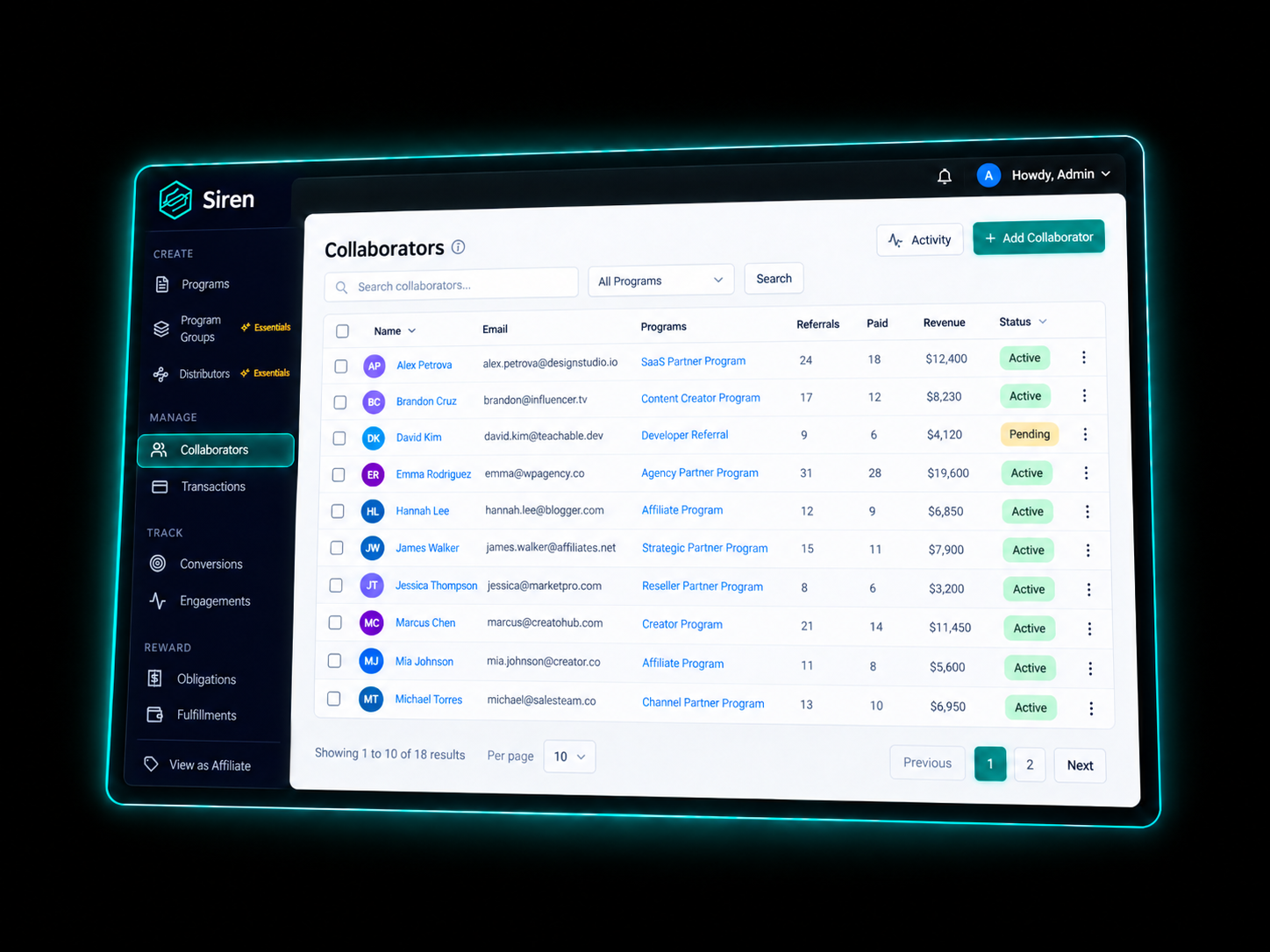
Siren is a flexible partner incentive and relationship management platform built for businesses that need to track partner contributions, assign credit, and reward measurable outcomes.
With Siren, you can run affiliate, referral, revenue-share, royalty, sales commission, and performance-bonus programs from the same incentive engine.
Here is everything you can do with Siren:
- Define which partners participate at each level of the commission structure.
- Apply percentage-based or flat commissions according to role, tier, product, or qualifying event.
- Split or stack rewards when multiple partners contribute to the same conversion.
- Separate attribution rules from commission calculations.
- Review and approve obligations before they move toward payout.
- Preserve an auditable record of who earned each commission, why they earned it, and how it was calculated.
- Operate affiliate, referral, revenue-share, and sales commission programs from the same system.
Siren’s partner management software centralizes partner records and relationships, while its commission tracking software manages the rules and obligations created across the hierarchy.
The result is a multi-tier commission program that can become more sophisticated without becoming impossible for your partner team or Finance department to explain.
Build the structure around the behavior you want
A successful multi-tier commission structure rewards the contributions that genuinely create value without making the program difficult to understand or operate. Start by mapping the value chain, identifying who contributes to each outcome, and using the fewest levels necessary to represent those relationships.
The goal is to build one program that:
- Encourages the right partner behaviors.
- Gives participants a clear understanding of how they earn.
- Allows operators to review and explain every calculation.
- Gives Finance an accurate, auditable record of every obligation.
- Can grow without relying on increasingly fragile spreadsheets and manual adjustments.
Frequently asked questions about multi-tier partner commissions
What is a multi-tier partner commission structure?
A multi-tier partner commission structure rewards more than one participant for the same sale, referral, or qualifying event. For example, a direct partner may earn the primary commission while a team leader, referring partner, agency, or upstream participant receives an additional override.
What is the difference between multi-tier and tiered commissions?
Multi-tier commissions distribute rewards across multiple participants or levels in a relationship. Tiered commissions change the reward rate when one participant reaches a performance threshold, such as generating 10, 25, or 50 sales. A program can use both models, but they solve different problems.
How many commission tiers should a partner program have?
A partner program should use the minimum number of tiers required to represent its real value chain. Every additional level introduces more calculations, explanations, potential disputes, and reconciliation work. If a tier does not reward a distinct contribution, it probably does not need to exist.
How can businesses prevent duplicate commission payments?
Businesses can prevent duplicate payments by defining clear attribution precedence, customer ownership rules, program eligibility, reward-stacking policies, and approval controls. Every commission should reference the qualifying event, credited participant, applied rule, and any other obligations created by the same transaction.
Are multi-tier partner commissions the same as MLM commissions?
No. Multi-tier commissions can compensate legitimate contributions from agencies, referral partners, team leaders, dealers, or sales representatives without rewarding participant recruitment. The structure becomes materially different when compensation depends primarily on recruiting additional members rather than generating customer or business value.