

The 5 Hidden Costs of Commission Errors in Partner Programs

Learn how commission errors damage partner trust, increase churn, and create finance reconciliation work—plus the controls that prevent them.
A commission error is normally a missed sale or an incorrect rate, but the real cost spreads into partner support, trust, activation, churn, finance reconciliation, and the next payout cycle.
This article explains where commission errors come from, how to measure their total cost, and which controls catch them before partners or finance do. The goal is not only accurate payment—it is a program that can show, quickly and consistently, why every partner earned what they earned.
TL;DR
- Commission errors include attribution, eligibility, calculation, approval, reversal, and payout failures—not only incorrect arithmetic.
- The total cost combines cash adjustments, support time, delayed close, partner inactivity or churn, and control risk.
- Prevention requires versioned rules, validated source data, exception queues, approval controls, and an audit trail from event to payout.
What counts as a commission error?
A commission error is any mismatch between the agreed program rule and the amount, recipient, status, or timing recorded and paid.
| Stage | Common error | Visible impact |
|---|---|---|
| Tracking | Missing or duplicated event. | Uncredited sale or double commission. |
| Attribution | Wrong partner, window, or precedence. | Dispute and distorted partner performance. |
| Eligibility | Ineligible customer, product, or territory included. | Overpayment and margin leakage. |
| Calculation | Wrong base, rate, tier, cap, or currency. | Incorrect obligation and accrual. |
| Approval | Manual exception bypasses review. | Weak controls and inconsistent treatment. |
| Reversal | Refund or chargeback is not linked back. | Commission remains payable after revenue reverses. |
| Payout/reconciliation | Wrong payee, failed payment, or batch mismatch. | Partner delay and finance rework. |
The error should be classified at the stage where it originated, not only where it became visible. A payout discrepancy may have started as a missing coupon association, stale customer ownership record, incorrect product eligibility rule, or refund that never reached the commission ledger.
5 Consequences of Partner Commission Errors
A commission mistake creates downstream work across Partner Ops, Finance, RevOps, support, and sometimes engineering—while also weakening the relationship with the partner who was affected.
1. Higher Correction and Operating Costs
Every error creates a second operational workflow. Someone must investigate the source data, reproduce the calculation, coordinate a decision, communicate with the partner, post an adjustment, and reconcile the result. The direct cost may include an overpayment, correction, payment fee, or foreign-exchange difference, but the larger cost is often the time required from Partner Ops, Finance, RevOps, support, and engineering.
In a survey of more than 90 companies, Xactly reported that 83% had compensation payment inaccuracies. Although the study focused on sales compensation, the same operational pattern applies to partner commissions: unclear rules and fragmented data create adjustments that consume time, money, and confidence.
2. Loss of Partner Trust
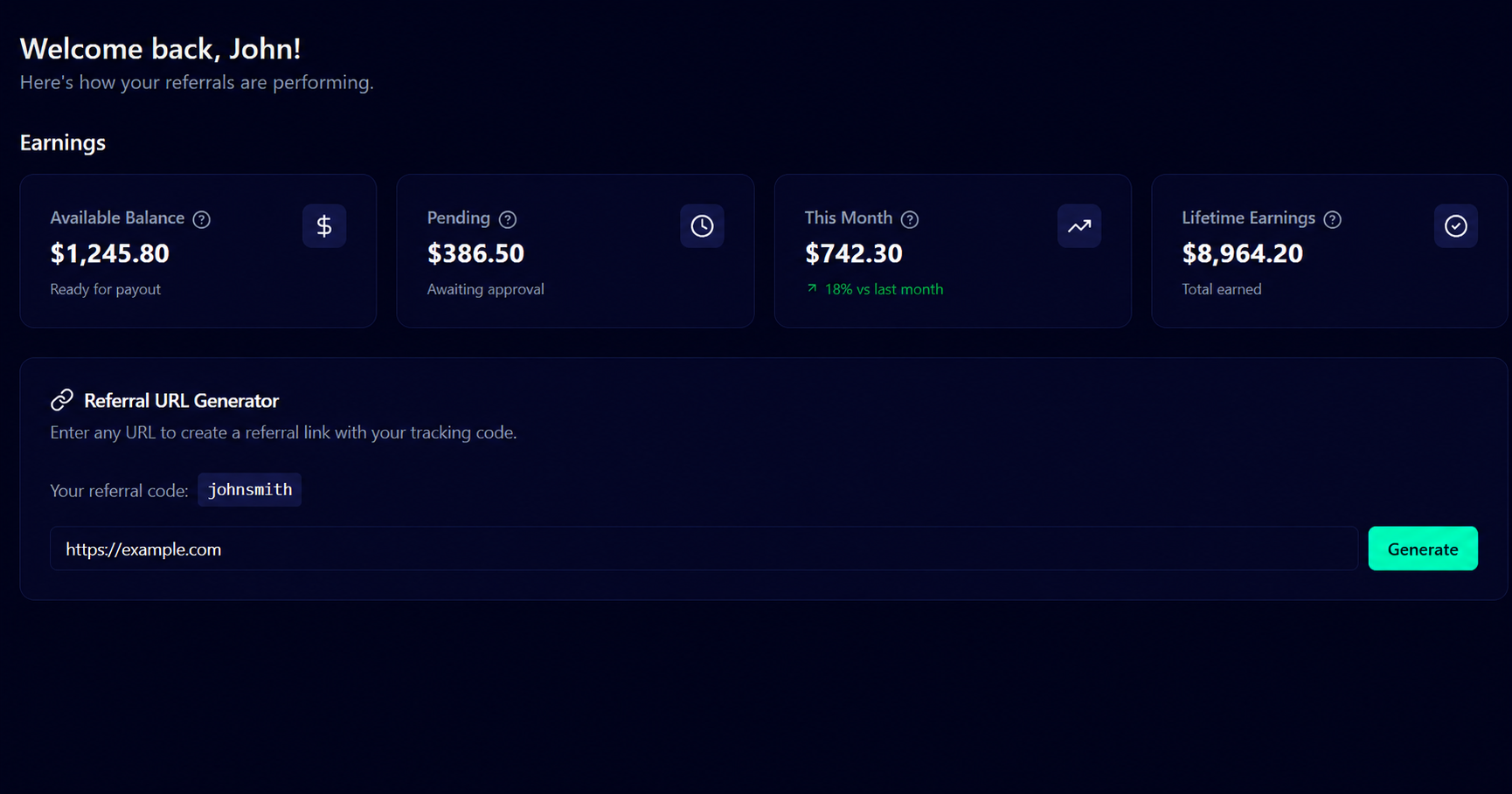
Partners need to connect their activity to a transparent earning record. Repeated discrepancies may also force partners to maintain their own shadow spreadsheets.
Trust improves when the program exposes the source event, attribution result, commission base, rate, approval status, and payout reference. A partner dashboard should show the same underlying records used by the operator, reducing uncertainty and avoidable support requests.
3. Partner Inactivity and Churn
Repeated payout errors reduce your partner activity and eventually increase churn because reliable earnings are part of the partner value proposition.
The Performance Marketing Association describes a channel involving more than 200,000 businesses and individuals. When productive partners can choose among many programs, a slow or opaque resolution gives them a good reason to prioritize another advertiser.
4. Slower Finance Reconciliation and Close
Commission discrepancies create unresolved accruals, manual journal entries, payout-to-ledger differences, and extra review during close. Refunds, chargebacks, cancellations, currency conversion, and late-arriving transactions make the problem harder when the commission system and accounting records do not share the same source data.
A corrected payout is not fully resolved until Finance can connect the adjustment to the original earning, approval decision, payment, and ledger entry. Without that trail, the same discrepancy can reappear in the next payout cycle or month-end reconciliation.
5. Weaker Controls and Repeated Disputes
When a team resolves errors manually, it weakens the audit trail and makes future decisions inconsistent.
Strong controls preserve the rule version, effective date, attribution evidence, approval history, adjustment reason, and payout reference. This does more than satisfy an audit: it helps teams identify recurring error categories and fix the underlying process instead of repeatedly correcting the same symptom.
3 reasons why commission errors happen
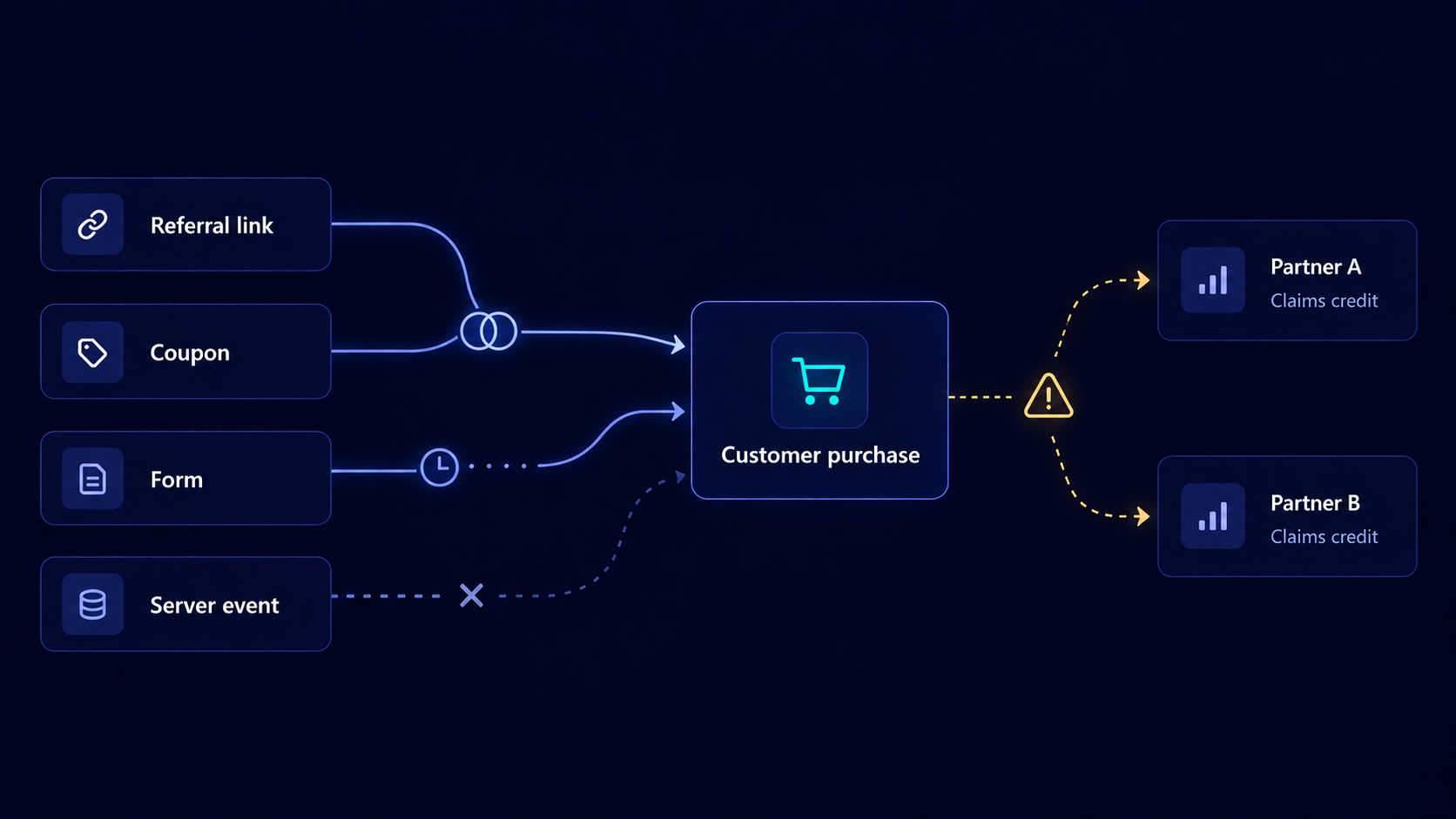
Most commission errors happen at the boundaries between systems, teams, and rule versions. The more exceptions a program manages in spreadsheets or email, the harder it becomes to know which version is authoritative.
Source-data failures
- Missing or duplicated orders, leads, refunds, or subscription events.
- Unstable customer or partner identifiers across CRM, checkout, and partner platform.
- Late-arriving events posted after a payout period is locked.
- Incorrect tax, shipping, discount, or eligible-line-item values.
Attribution failures
- Referral links, coupons, forms, and server events apply different precedence.
- Lookback windows differ across tools.
- Customer ownership is missing, stale, or applied after last-click credit.
- Cross-device or privacy restrictions interrupt the expected path.
Rule and workflow failures
- Rates change without an effective date or frozen rule version.
- Tier thresholds use pending revenue in one report and approved revenue in another.
- Overlapping programs pay the same outcome twice.
- Manual overrides bypass approval or are not included in the audit trail.
- Refund logic treats pending and already-paid commissions the same way.
A Partner Relationship Management operating model reduces these boundary failures by linking partner records, attribution, reward rules, approvals, and payouts around the same source events.
How much does a commission error really cost?
Measure the total cost as direct adjustment plus handling labor, payout delay, partner impact, and control remediation.
You can use this internal formula:
Total error cost = cash adjustment + processing fees + staff hours × loaded hourly cost + close-delay cost + estimated partner opportunity cost + control-remediation cost.
Example
A $300 underpayment may require two hours from Partner Ops, one hour from Finance, and 30 minutes from RevOps. If the loaded labor cost totals $210, a $20 expedited payment fee is added, and the partner pauses a campaign expected to produce $1,000 in contribution margin, the economic exposure is not $300—it is $1,530 plus the trust impact.
Keep the trust component separate unless you can connect the incident to measured inactivity or churn. This prevents a useful model from becoming fake precision.
How to prevent errors before payout?
Teams prevent commission errors by validating each transition from source event to cash, with explicit ownership and a controlled exception queue. The goal is to stop errors early while preserving enough evidence to resolve genuine exceptions quickly.
- Validate source events: deduplicate orders and confirm stable customer, partner, and transaction IDs.
- Resolve attribution first: apply lookback, ownership, coupon, and split-credit precedence before reward calculation.
- Version reward rules: store rate, base, threshold, cap, and effective dates with every obligation.
- Separate states: pending, approved, declined, payable, paid, and adjusted should not collapse into one amount.
- Run pre-payout controls: compare totals with prior periods, active partners, revenue, reversals, and concentration.
- Approve exceptions: require a reason, owner, and second reviewer for manual adjustments above a threshold.
- Reconcile cash: match payout batches and processor references back to itemized obligations.
Siren’s features overview follows this chain from click or action to attribution, commission owed, approval, payout, and audit history. Its commission tracking software treats each commission as an itemized obligation rather than a single unexplained balance.
How can Siren reduce commission-error risk?
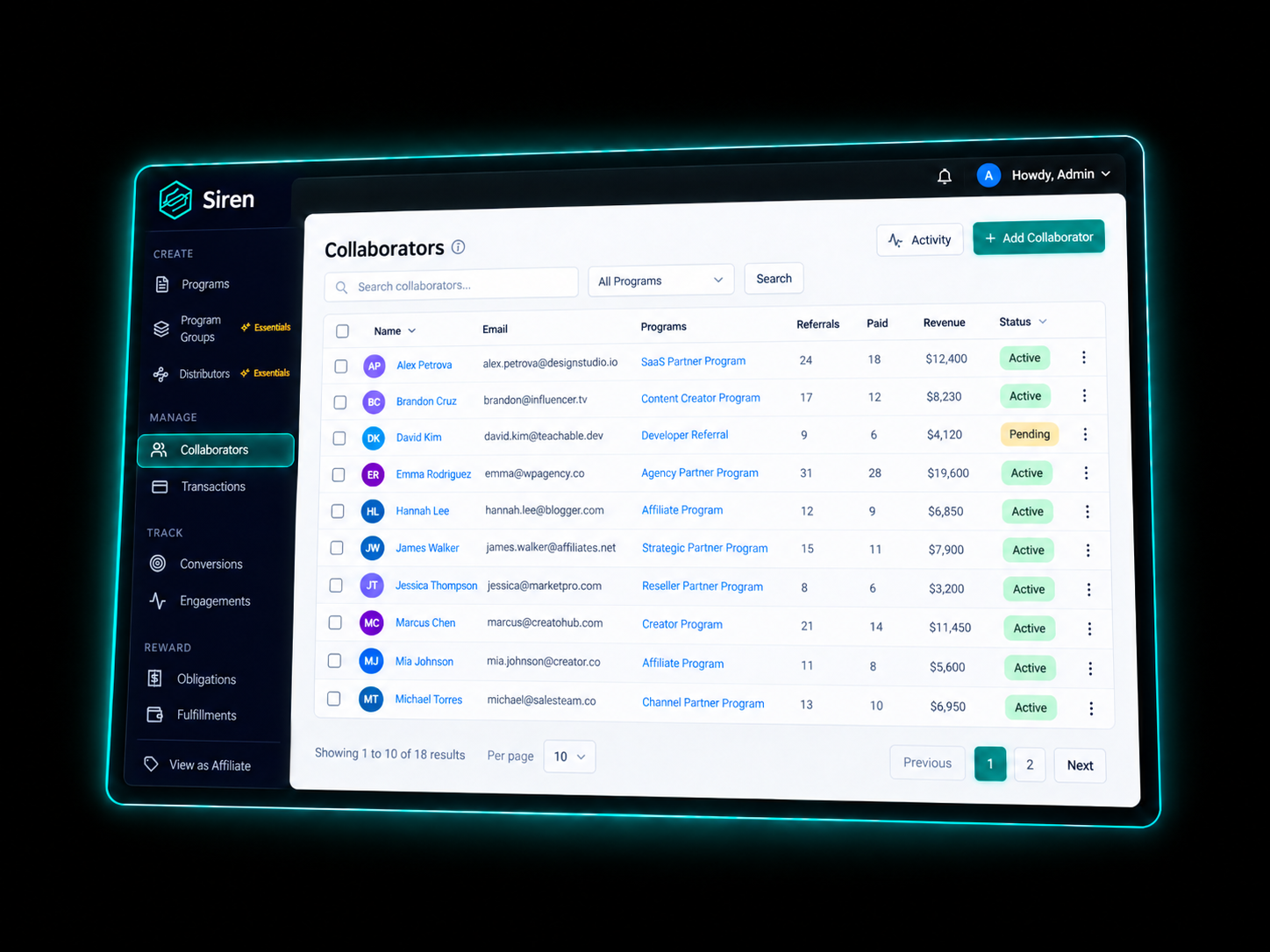
Siren reduces commission-error risk by connecting first-party affiliate tracking, program rules, itemized commission obligations, approval states, payouts, refunds, and an append-only audit trail. That gives operators and finance a shared record of what happened and why.
Here is everything you can do with Siren:
- Define which partners participate at each level of the commission structure.
- Apply percentage-based or flat commissions according to role, tier, product, or qualifying event.
- Split or stack rewards when multiple partners contribute to the same conversion.
- Separate attribution rules from commission calculations.
- Review and approve obligations before they move toward payout.
- Preserve an auditable record of who earned each commission, why they earned it, and how it was calculated.
- Operate affiliate, referral, revenue-share, and sales commission programs from the same system.
Siren is best for businesses managing different types of growth partners and needing flexible rules for tracking contributions, attributing outcomes, and calculating rewards.
Accuracy is a growth capability
Accurate commissions protect margin, but their larger value is operational confidence. Partners promote without shadow accounting, managers spend less time on disputes, and finance can close the payout cycle from evidence instead of reconstruction.
Explore Siren’s commission tracking software to see how rewards move from source event to attribution, approval, payout, refund handling, and audit history in one operating record.
Frequently Asked Questions
What is a partner commission error?
A partner commission error occurs when a partner receives the wrong reward or when their earnings are calculated, attributed, approved, or paid incorrectly. Common examples include missing conversions, duplicate commissions, incorrect rates, unexplained reversals, and payments assigned to the wrong partner.
What causes most partner commission errors?
Most errors originate from incomplete source data, conflicting attribution rules, outdated commission structures, or disconnected systems. Manual overrides and spreadsheet-based processes also increase risk when changes are not documented or included in an audit trail.
Can commission errors increase partner churn?
Yes. Repeated or poorly explained payment errors can reduce partner trust, promotional activity, and participation. Partners are more likely to prioritize another program when they cannot reliably connect their contributions to their earnings.
How should a business correct an underpaid commission?
The business should confirm the source event, reproduce the original calculation, document the cause, and issue a clearly labeled adjustment. The partner should also receive an explanation showing the original earning, corrected amount, adjustment reason, and expected payment date.
How can companies prevent commission errors?
Companies can reduce errors by centralizing source data, defining clear attribution and eligibility rules, preserving effective dates and rule versions, introducing approval workflows, and reconciling commissions before each payout. Exceptions should be documented and reviewed instead of resolved through private spreadsheets or email.
How does Siren help reduce commission-error risk?
Siren connects tracked events, attribution, program rules, reward calculations, approvals, adjustments, and payout status within the same system. It also helps businesses manage multiple partner and incentive programs while maintaining separate rules and a clearer record of why each commission was earned.