

9 Signs Your Manual Affiliate Tracking Is Getting Too Risky

Learn the nine warning signs that manual affiliate tracking is exposing your program to attribution, commission, reconciliation, and payout risks.
As your affiliate or partner program grows, keeping everything organized can get harder. At some point, you may need a dedicated tool to avoid tracking errors and payout mistakes.
But how do you know when you’ve reached that point?
After several years in the industry and conversations with affiliate managers, we’ve learned to recognize the warning signs. In this article, we break down nine signs that manual affiliate tracking and management are becoming too risky.
In other words, signs that tell you: it’s time to get software to manage your program!
TL;DR
- Manual tracking can work for a simple, controlled pilot when transactions are easy to verify and commission rules are consistent.
- Move beyond it when attribution, calculations, adjustments, or payments become difficult to reconstruct.
- Affiliate count alone is a weak decision rule. Transaction volume, sales channels, exceptions, and the money exposed to mistakes matter too.
- Keep human review where judgment is necessary. Automate the capture, calculation, and recordkeeping that should behave consistently.
What counts as manual affiliate tracking?
Manual affiliate tracking means people collect referral evidence, connect it to sales, calculate commissions, and maintain payment records through spreadsheets, messages, exports, or other disconnected tools.
There are different levels of manual work:
| Workflow | What happens manually |
|---|---|
| Manual referral recording | A partner emails an introduction, and someone records the resulting sale. |
| Manual commission calculation | Sales are tracked elsewhere, but a spreadsheet calculates partner earnings. |
| Manual reconciliation | Someone joins order exports, affiliate records, refunds, and payment files. |
| Manual payout administration | A manager prepares payments and updates their status afterward. |
Manual work is not automatically a problem. Reviewing a disputed referral or approving an unusual commission requires a person.
The risk appears when reliable tracking depends on someone remembering to copy, interpret, or update information correctly every time.
A discussion about adopting affiliate management software makes that distinction useful: the work extends beyond counting referred sales into links, private rates, reversals, payment records, and disputes.
9 signs your manual affiliate tracking is becoming too risky
| Warning sign | The question your process should answer |
|---|---|
| You cannot trace a commission to its source | Why did this partner receive credit for this transaction? |
| Tracking is not tested after website changes | Does the complete referral journey still work? |
| Links and coupons produce competing claims | Which attribution rule decides who earns? |
| Commission rules live in messages | Which terms applied when this sale happened? |
| Refunds and renewals require separate cleanup | Does the commission reflect the transaction’s current eligibility? |
| Duplicate records can create duplicate rewards | Has this entitlement already been recorded or paid? |
| Payment status depends on a spreadsheet checkbox | Was the payment completed, and which earnings did it cover? |
| Only one person understands the process | Can someone else reproduce the calculation and decision? |
| New stores and channels create disconnected records | Can you reconcile the program across every relevant sales source? |
1. When you cannot trace a commission back to the transaction
A commission is difficult to defend when its supporting evidence is missing.
An affiliate says they referred a customer. Your spreadsheet contains their name and a commission amount, but no order ID or documented introduction.
For each commissioned outcome, preserve the connection between:
- The qualifying transaction or lead.
- The partner who received credit.
- The evidence supporting that credit.
- The attribution rule applied.
- The resulting commission.
UTM parameters can help describe marketing traffic. They are not, by themselves, a complete commission record.
What to change: Require a source transaction ID and attribution evidence before an entry becomes payable. Use the same standard for every partner, including your best performers.
2. When your referral journey changes quickly
Tracking becomes unreliable when the website evolves faster than your checks.
Changes on your website can change the path between a referral and a purchase. A partner’s link may still open the correct page while the later qualifying event is no longer recorded.
A useful test follows the whole journey:
- Open a known affiliate link.
- Reach the intended destination.
- Complete the qualifying action.
- Confirm the credited partner.
- Check the commission and approval status.
What to change: Add referral testing to the release checklist for checkout changes, migrations, new forms, and new sales channels. Check outcomes, not just whether the link loads.
3. When affiliate links and coupon codes create competing claims
You need an attribution policy before two partners claim the same sale.
This happens when a customer clicks Partner A’s review, returns later through Partner B’s link, and purchases using Partner C’s coupon code.
Your spreadsheet cannot decide who deserves credit unless the business has already defined the rule.
Possible policies include:
- First eligible referral receives credit.
- Last eligible referral receives credit.
- An assigned coupon takes precedence.
- Several qualifying contributions share a defined reward.
- Conflicting claims require review.
What to change: Write the precedence rules, attribution window, and exception process into the program terms. Then confirm that your tracking implementation can apply them.
For a fuller policy framework, see how to prevent referral attribution and commission disputes.
4. If your commission rules are not properly documented and communicated
Your partners should know what earns a commission, how it’s calculated, and when it becomes payable.
Keep those rules in one documented program policy, configure your system to match, and communicate any changes before they take effect.
What to change: Maintain a clear rule register with effective dates, eligible outcomes, calculation bases, rates, and exceptions. Connect each commission to the terms that produced it.

5. When commissions aren’t updated when orders change
A refund or cancellation can change what an affiliate should earn. If you track sales manually, it’s easy to miss that change and pay a commission that no longer qualifies.
Define how refunds, cancellations, and subscription renewals affect commissions, then keep those rules connected to your records. Before each payout, check that the amount reflects the eligible revenue, not just the original sale.
6. You’re paying the same commission twice
Importing the same sale twice or including it in overlapping programs can lead to duplicate commissions.
Use a unique transaction ID to check for repeated sales, and define which programs should pay. Multiple rewards can be intentional, such as an affiliate commission and a creator royalty, but they should follow your rules.
7. You can’t confirm whether a partner was paid
Marking a row as “Paid” doesn’t confirm that the payment went through. A transfer might fail, or an exported payment file might never be processed.
Keep pending, approved, and paid commissions separate. Before marking a payout as complete, confirm the payment and save its reference.
8. Only one person understands the spreadsheet
If nobody else can explain the calculations or prepare a payout, the program depends too much on one person.
Document the formulas, partner agreements, and adjustments in one place. Another team member should be able to check a commission without searching someone’s inbox.
9. Each sales channel needs a separate spreadsheet
Selling across multiple stores or platforms adds more records to check and more chances to miss a sale or pay twice.
Keep each sale connected to its store, transaction ID, partner, and commission. If combining exports and checking payments takes more work every month, your manual setup may no longer fit the program.
Example: a small calculation error can expose a bigger process problem
Let’s take this example: the program pays 10% of merchandise revenue after discounts, excluding tax and shipping.
| Order component | Amount |
|---|---|
| Merchandise | $200 |
| Discount | -$20 |
| Tax | $18 |
| Shipping | $12 |
| Customer’s total payment | $210 |
| Eligible commission base | $180 |
| Correct commission at 10% | $18 |
Calculating 10% of the customer’s total payment produces a $21 commission. The arithmetic is correct; the commission base is wrong.
Now suppose the customer receives a $50 refund against eligible merchandise. Under this example’s terms:
- The eligible base falls from $180 to $130.
- The revised commission is $13.
- The required adjustment is $5.
A reliable process can show the original calculation, refund, adjustment, approval decision, and payment impact.
If the spreadsheet only contains the latest commission amount, the team may struggle to explain what changed.
Manage affiliate tracking and commissions with Siren
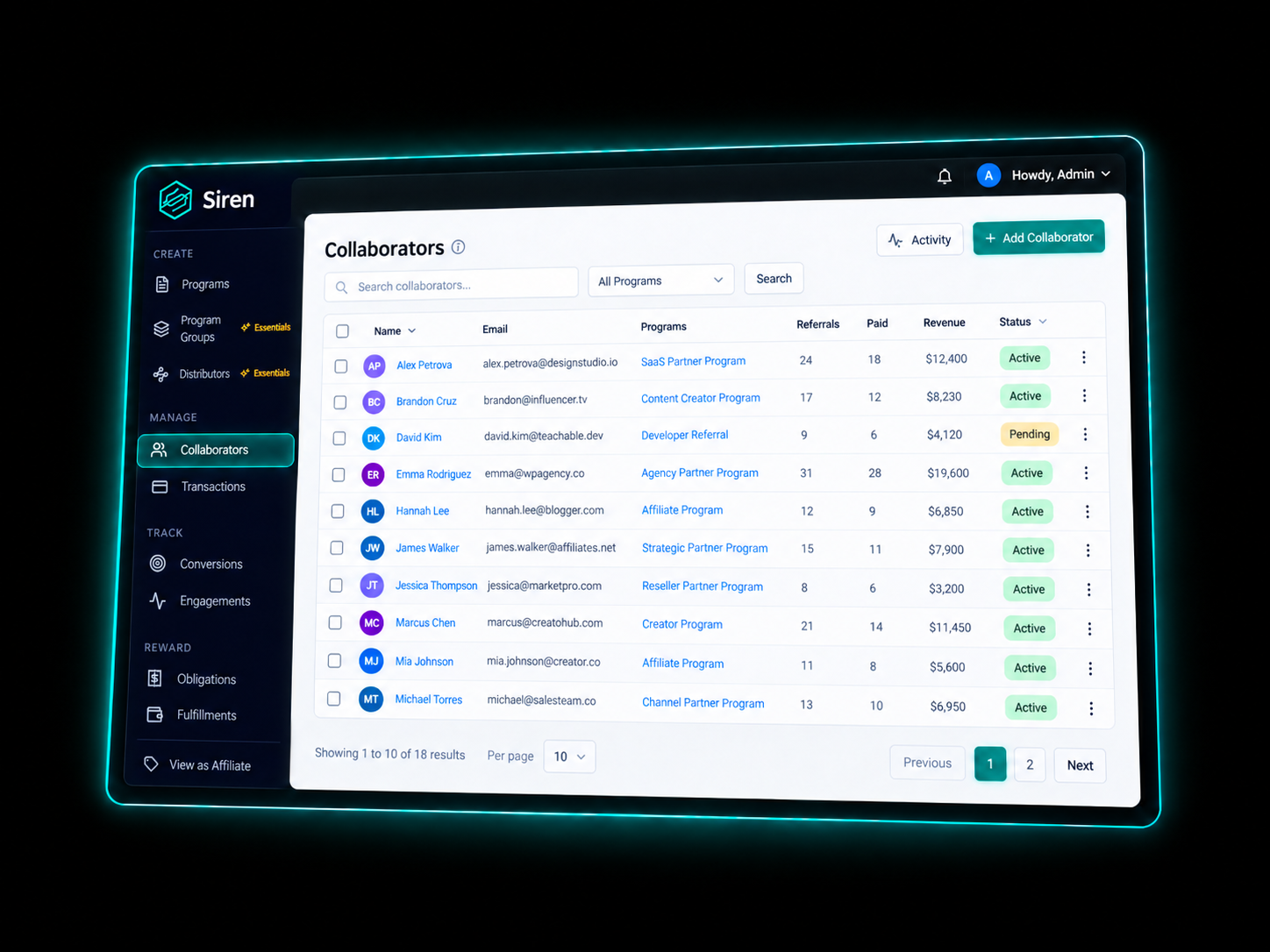
Keep referrals, commission rules, and payment records in one place as your partner program grows.
With Siren, you can:
- Track referrals: Connect affiliate links and coupon codes to the sales they generate.
- Apply your commission rules: Calculate rewards and decide when programs should stack or only one should pay.
- Manage approvals and payouts: Review commissions before payment and keep a record of what each partner earns and receives.
Choose hosted Siren Cloud or run Siren on your WordPress site.
Test your current process before the next payout
Choose recent examples that represent how your program actually works: an ordinary sale, a refund or cancellation, a partner-specific rate, and a completed payout.
For each one, ask:
- Can we identify the source transaction and credited partner?
- Can we show the rule and commission base?
- Can we explain every adjustment?
- Can we establish whether the earnings were approved and paid?
- Can another team member reproduce the answer?
The first missing answer identifies the next control to improve.