

Is an Affiliate Program Right for Your Business in 2026?

Learn when an affiliate program makes sense for your business, when it may not be the right fit, and what to prepare before launching one.
Many businesses, especially small and mid-sized ones, ask the same question before launching a new growth channel: Is an affiliate program actually right for us?
Affiliate programs are attractive because they are built around performance. That is one reason this channel has become such an important part of growth.
Affiliate marketing is still growing: industry estimates project affiliate marketing spending to exceed $10 billion by 2026.
This guide will help you decide whether an affiliate program is right for your business, what to prepare before launching, and which tools can help you build the program properly.
TL;DR
- An affiliate program is right for your business if you already have a product people want to recommend, a funnel that converts, and enough margin to pay rewards.
- The best way to start is to choose one clear action to reward, recruit a small group of aligned affiliates, set simple rules, and track whether the program drives real business outcomes.
- With Siren, you can start with an affiliate program and later expand into referrals, partner incentives, customer rewards, revenue share, royalties, commissions, or performance bonuses.
What Is an Affiliate Program?
An affiliate program pays partners a commission when the people they refer make a purchase.
That result is usually a sale, but it can also be a lead, signup, subscription, demo request, account upgrade, or another action that matters to the business.
In general, the affiliate promotes the product through a referral link or a coupon code. When their promotion leads to the agreed action, they earn a commission or reward.
Is an Affiliate Program Right for Your Business?
An affiliate program can be right for your business if you already have something people want to recommend, a clear action you want to reward, and enough margin to pay commissions when affiliates drive results.
It is usually a good fit when your product or service already converts, your customers or partners naturally talk about it, and there are creators, publishers, consultants, agencies, customers, or industry experts who could introduce it to the right audience.
It may not be the right fit yet if your offer is still unproven, your website does not convert, your margins are too thin, or you are expecting affiliates to create demand from nothing.
A simple way to think about it is this: an affiliate program should help you scale a growth motion that already has some proof. It should not be used to fix a product, offer, or funnel that is not working yet.
Fit is one question; exposure is another. If almost all of your current growth arrives through a single channel, it is worth reading how channel concentration risk works before you decide what an affiliate program is actually for.
Summary: When an Affiliate Program Makes Sense vs. When It Does Not
| An affiliate program makes sense when… | It may not be the right fit when… |
|---|---|
| Your product or offer already converts through existing channels. | Your offer is still unproven and customers are not buying yet. |
| You have enough margin to pay commissions while staying profitable. | Your margins are too thin to offer a reward that motivates affiliates. |
| Customers, creators, partners, or industry experts already recommend you informally. | You do not know who would realistically promote your product. |
| Your product benefits from trust, education, reviews, tutorials, or recommendations. | Your website, landing page, checkout, or sales process does not convert referred traffic. |
| You can clearly define the action that should trigger a reward, such as a sale, lead, signup, or subscription. | Your sales cycle is too complex to track and you do not have a clear attribution process. |
| You are ready to recruit, onboard, support, and communicate with affiliates. | You expect the program to grow passively without ongoing management. |
| You want to scale a growth motion that already has some proof. | You are trying to use affiliates to fix a product, offer, positioning, or funnel problem. |
8 Benefits of Starting an Affiliate Program
An affiliate program can help your business grow through trusted recommendations, partner-driven promotion, and performance-based rewards:
- Performance-based growth: You reward affiliates when they drive a measurable result, such as a sale, lead, signup, subscription, or qualified customer. This keeps the program tied to real business outcomes.
- Lower upfront risk than paid ads: Instead of paying upfront for impressions, clicks, or reach, you pay when the agreed action happens. This can make affiliate programs attractive for businesses that want a more outcome-driven acquisition channel.
- Borrowed trust: Affiliates, creators, publishers, consultants, and partners can introduce your product to audiences that already trust them. That trust can make their recommendation more persuasive than a cold ad.
- More distribution channels: Affiliates can promote your business through blogs, newsletters, YouTube, social media, podcasts, comparison pages, communities, product reviews, and partner websites.
- SEO and content visibility: Some affiliates create reviews, tutorials, listicles, comparisons, and use-case content that can help your brand appear in more search journeys.
- Scalable word-of-mouth: If customers, creators, or partners already recommend your product informally, an affiliate program gives that behavior a formal structure with tracking, rewards, and clear rules.
- Better partner motivation: Clear commissions or rewards give affiliates a reason to keep promoting your product, especially when they can see how their activity connects to earnings.
- A foundation for other incentive programs: Once you have tracking, attribution, reward logic, and payout rules in place, you can expand into referrals, partner incentives, customer rewards, revenue share, royalties, commissions, or performance bonuses.
Best Practices Before You Start
Before launching an affiliate program, the first question is whether you can create a partnership that actually helps both sides.
You do not need a massive affiliate network to start seeing results. A better approach is to start with one high-quality partner whose audience naturally needs your product, already trusts them, and can realistically take action on their recommendation.
That also means your product should be validated before you ask someone to promote it. An affiliate partnership should be a way to bring a proven offer to a relevant audience, generate sales, and make the partner feel like the collaboration was worth repeating.
Before you start, focus on three things: choose an affiliate whose audience is aligned with your offer, start with a relationship or warm introduction when possible, and make the first launch simple enough to manage and learn from.
Related Reading: How To Find Your First Successful Affiliate.
What Type of Affiliate Program Should You Launch?
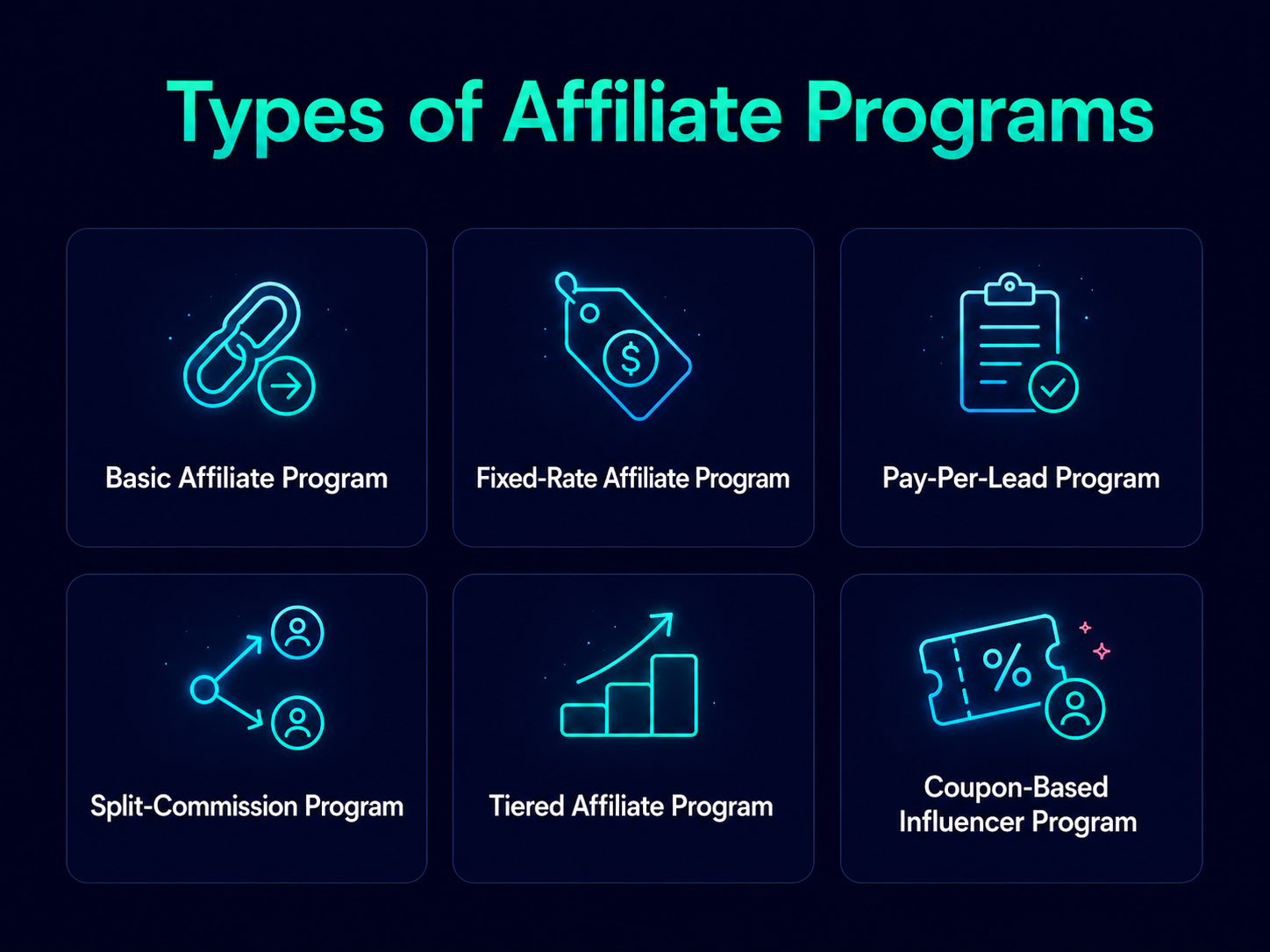
The right affiliate program depends on what you sell, who can promote it, and what action you want to reward.
Here are a few common types of affiliate programs you can start with:
- Basic affiliate program: Best for businesses that want to reward affiliates when they drive a completed sale or conversion. This is the simplest starting point if you want to test affiliate marketing without adding complex commission rules.
- Fixed-rate affiliate program: Best when you want to pay the same reward for every qualifying sale or action. This works well when you want predictable commission costs instead of percentage-based payouts.
- Pay-per-lead affiliate program: Best when affiliates should be rewarded for generating qualified leads, demo requests, form submissions, or sales opportunities rather than completed purchases.
- Split-commission affiliate program: Best when more than one affiliate, partner, or touchpoint may influence the same sale. Instead of giving all credit to one person, the commission can be split between multiple contributors.
- Tiered affiliate program: Best when you want to motivate affiliates to keep improving performance over time. Affiliates can unlock better commission rates, bonuses, or rewards as they reach higher sales, lead, or revenue milestones.
- Coupon-based influencer affiliate program: Best when creators promote through coupon codes on social media, podcasts, livestreams, YouTube, or offline channels where buyers may not click a referral link immediately.
5 Affiliate Program Tools to Consider
Here are the best tools to start in the affiliate world:
| Tool | Why is it a good fit | Pricing |
|---|---|---|
| Siren Affiliates | It is a great fit if you want to start with affiliates and later expand into other program types: referrals, partner incentives, customer rewards, revenue share, royalties, commissions | Free plan available. Paid WordPress, Cloud Self-Serve, and Full-Service options are available depending on where the program will run. |
| AffiliateWP | Best for WordPress businesses that want a popular affiliate plugin focused on traditional affiliate program management, affiliate dashboards, referral links, tracked coupons, commissions, and payouts. | Paid plans. Personal plan starts at $149.50/year on current promotional pricing. |
| Rewardful | Best for SaaS companies using Stripe or Paddle that want affiliate and referral tracking tied to subscription billing, recurring commissions, coupon tracking, and affiliate portals. | Paid plans with a 14-day free trial. Starter plan starts at $49/month. |
| PartnerStack | Best for B2B SaaS companies that want a productized partner ecosystem, affiliate tracking, partner recruitment, marketplace access, and support for multiple partner motions. | Paid plans paid annually, with custom Enterprise pricing. |
| Refersion | Best for ecommerce brands that want affiliate and influencer tracking connected to online sales, coupon codes, commission management, and partner performance. | Paid platform. Pricing should be checked directly based on current plan availability. |
How to Start an Affiliate Program With Siren
Siren gives you a practical way to start an affiliate program and then expand into referrals, partner incentives, customer rewards, revenue share, royalties, commissions, or performance bonuses as your strategy grows.
Step 1: Choose Where Your Program Needs to Run
Start by choosing the Siren setup that matches where your program needs to operate.
If your site runs on WordPress, Siren gives you a WordPress-native way to create and manage an affiliate program close to your existing website.
If your affiliate program needs to run across a broader stack, multiple channels, or a hosted environment, Siren Cloud gives you a more flexible implementation path.
Step 2: Define the Action That Should Trigger a Reward
Decide what affiliates should be rewarded for. That can be a completed purchase, qualified lead, signup, demo request, subscription, account upgrade, renewal, or another measurable action that matters to your business.
Step 3: Set Reward Logic and Attribution Rules
Once the rewardable action is clear, define how credit and commissions should work.
You can decide who gets credit, how rewards are calculated, whether the commission is percentage-based or flat, and whether rewards should be reviewed before approval.
Clear attribution and reward rules help affiliates understand how the program works and help your team avoid confusion later.
Step 4: Invite Affiliates and Track Performance
Start with a focused group of affiliates, partners, customers, creators, consultants, or publishers who are already aligned with your audience.
Give them the links, messaging, and program rules they need to promote your offer. As activity comes in, track referred actions, commissions, approvals, and payouts through Siren.
Siren also has a full interactive demo you can explore before signing up or paying. You can see how programs are created, managed, tracked, and rewarded inside the platform.
Final Takeaways
An affiliate program works best when you already have a product people want to recommend, a conversion path that works, enough margin to pay rewards, and a clear idea of who could promote your offer.
It may not be the right fit yet if your product is unproven, your website does not convert, your margins are too thin, or you expect affiliates to create demand from nothing.
The best way to start is to choose a specific action to reward, recruit a small group of aligned affiliates, give them clear rules and useful resources, and track whether the program is driving real business outcomes.
Once the first program works, you can expand into more sophisticated incentive models, such as referrals, influencer affiliate campaigns, partner incentives, customer rewards, revenue share, royalties, commissions, or performance bonuses.
With Siren, you can start with an affiliate program and keep room to grow into a broader incentive system without rebuilding your stack every time your strategy evolves.