

Build a Profitable SaaS Pay-Per-Lead Program (2026)

Learn how to build a SaaS pay-per-lead program, define qualified leads, set payouts, recruit affiliates, prevent fraud, and track results.
What Are Pay-Per-Lead Programs?
A pay-per-lead (PPL) program is an affiliate compensation model in which a SaaS company pays a partner when a referred prospect completes a predefined qualifying action. The commission is triggered by the creation of a valid lead.
For a SaaS company, that qualifying action might be a verified free-trial signup, an activated account, a demo request, an attended sales call, or a contact that matches the company’s ideal customer profile. The exact event depends on the product, sales motion, customer value, and how much influence the affiliate has over the outcome.
In simple terms, the company is paying for a genuine acquisition opportunity. The affiliate is being rewarded for introducing a suitable prospect, while the SaaS company remains responsible for converting that prospect into an activated user or paying customer.
Who Is a Pay-Per-Lead Program Best For?
- Service businesses that convert customers through consultations, demos, or quote request forms
- SaaS companies that want affiliates driving trial signups or free registrations
- Lead-dependent businesses where form submissions are worth a predictable dollar amount, and sales happen offline or later in the funnel
Why Pay-Per-Lead Matters in SaaS
A pay-per-lead program creates another growth path. The goal is not to depend entirely on advertising platforms to find prospects; with this type of structure, your SaaS can work with affiliates and other partners that already have relevance or trust within its target market.
- 33% of B2B buyers said they relied more on peer recommendations and reviews. Source: Demand Gen Report 2024 B2B Buyer’s Survey.
- 54% of buyers spoke with a current user before purchasing a SaaS tool. Source: TrustRadius 2025 B2B Buyer Research Report.
- The UK affiliate industry generated an estimated GBP 17 in advertiser revenue for every GBP 1 invested in 2023. Source: APMA State of the Nation 2024.
What a Pay-Per-Lead Program Can and Cannot Solve
We’ve seen pay-per-lead come up in countless conversations as a promising new growth channel for SaaS companies. And after implementing dozens of these programs, we’ve learned where they can make a real difference and where they can’t.
A well-designed program can become an important part of a SaaS growth strategy. But it won’t fix weak product-market fit or a broken funnel.
Here’s what a pay-per-lead program can actually solve and what it can’t:
| What PPL can solve | What PPL cannot solve |
|---|---|
| Paying for qualified outcomes instead of traffic | A weak SaaS offer |
| Creating a more predictable cost per accepted lead | Poor product-market fit |
| Expanding beyond in-house acquisition channels | An unclear ideal customer profile |
| Reaching audiences the company cannot access directly | A broken signup or demo funnel |
| Motivating affiliates during long sales cycles | Low product activation |
| Turning referrals and introductions into a measurable channel | Slow sales follow-up |
| Generating pipeline without waiting for closed revenue | Poor lead-to-customer conversion |
| Scaling a validated acquisition motion through partners | Weak affiliate recruitment or a lack of trust |
Is Your SaaS Ready for a Pay-Per-Lead Program?
A SaaS company is ready for a pay-per-lead program when it can define, track, and economically support a qualified lead. Use this checklist before recruiting affiliates.
Your SaaS Is Probably Ready If
- You have a clear ICP and an offer that already converts.
- You can define a qualified lead with objective, auditable criteria.
- You know the conversion rate from signup or demo to paid customer.
- You understand CAC, LTV, gross margin, and the maximum sustainable payout.
- You can distinguish new leads, duplicates, existing accounts, and activated users.
- Sales or lifecycle teams can follow up quickly.
- You can track each referral from source through activation and revenue.
How a SaaS Pay-Per-Lead Program Works
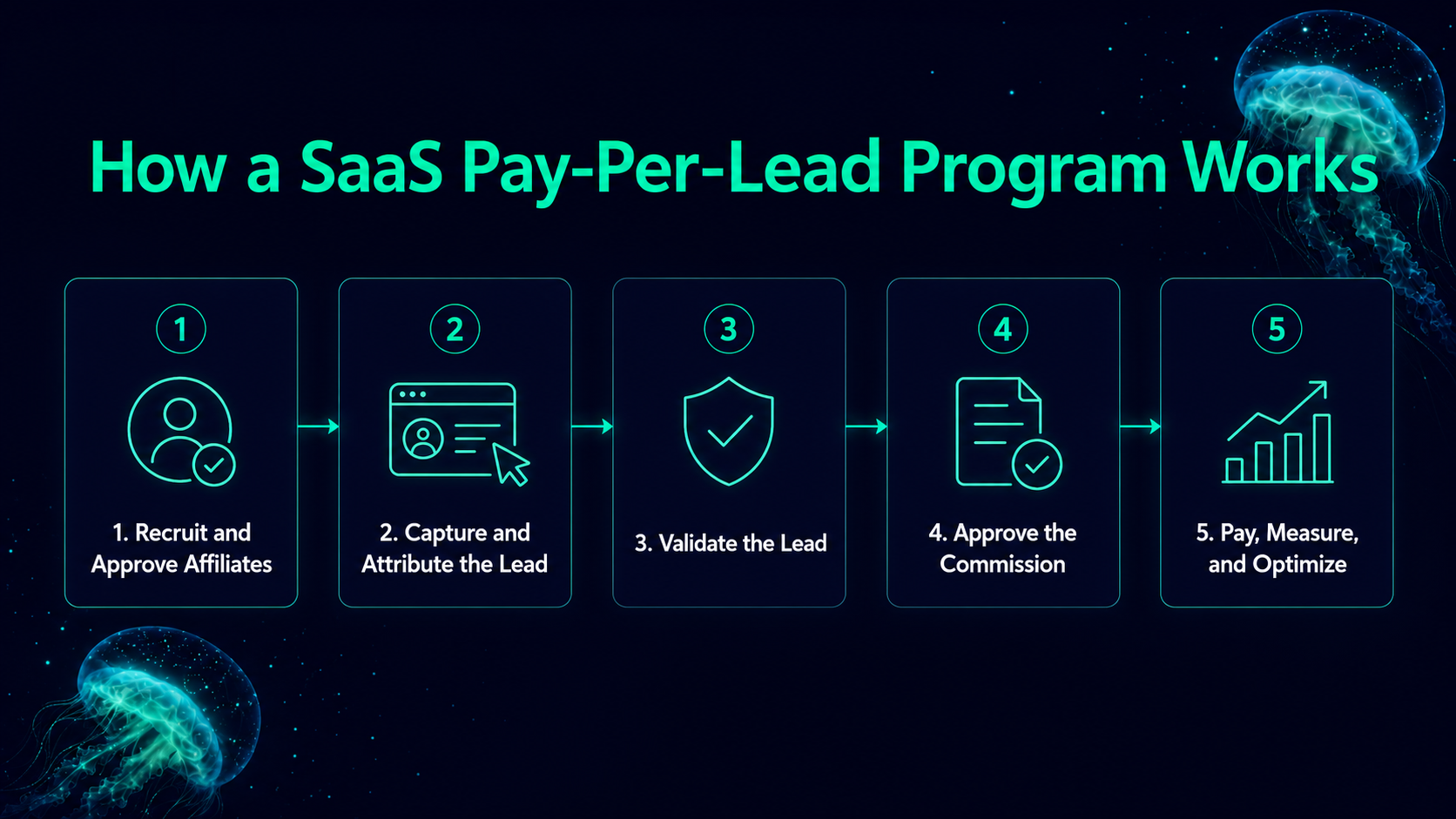
A SaaS pay-per-lead program connects an affiliate referral to a predefined lead event, validates the result, and rewards the affiliate when the lead meets the agreed criteria.
- Recruit and approve affiliates. Vet their audience, promotional methods, traffic sources, and compliance practices.
- Capture and attribute the lead. Affiliates generate leads through tracked links, referral forms, CRM introductions, or other approved methods.
- Validate the lead. Confirm ICP fit, consent, contact information, geography, duplicates, existing accounts, and potential fraud.
- Approve the commission. Once the qualifying event is verified, approve the payout or provide a clear reason for rejection.
- Pay, measure, and optimize. Pay affiliates on schedule and track downstream outcomes such as activation, opportunities, revenue, and churn.
What Should Count as a Qualified SaaS Lead?
A qualified SaaS lead is a new, legitimate prospect who intentionally completes the agreed action and meets the program’s objective eligibility rules.
The definition should stop at an outcome the affiliate can reasonably influence, but sit close enough to revenue to have predictable value. If the company cannot consistently verify the criteria and explain its decision to the affiliate, the event is not ready to be used as a payable lead.
Related: How to Avoid Low-Quality Affiliates in Your Affiliate Program
How Much Should Your SaaS Pay Per Lead?
There is no universal “right” payout. A sustainable amount depends on the value of the resulting customer, the percentage of qualified leads that become customers, and the costs the company still carries after receiving the lead. Competitor payouts can provide context, but they cannot tell you what your unit economics can support.
Here is a formula you can implement:
Maximum sustainable CPL = expected gross profit per customer x lead-to-paid conversion rate - downstream cost per lead

How to Find the Right SaaS Affiliates
The best SaaS affiliates are not simply people with large audiences. They already influence how the company’s ideal customers discover problems, evaluate tools, or make buying decisions. Start by looking for trusted access to the ICP, then evaluate reach.
Who Makes a Strong SaaS Affiliate?
- Existing customers and power users who can recommend the product from experience.
- Consultants, agencies, and service providers that advise the same ICP.
- Integration and technology partners with complementary products.
- Industry experts, educators, and content creators with subject-matter authority.
- Communities, newsletters, podcasts, and niche publishers serving the target market.
- Operators and professional networks that regularly make relevant introductions.
Where to Find Potential Affiliates
- Customer success conversations, NPS responses, referrals, and product communities.
- The company’s CRM, partner database, and existing integration ecosystem.
- LinkedIn creators, newsletters, podcasts, YouTube channels, and industry blogs.
- Search results for category education, comparisons, implementation advice, and buyer questions.
- Relevant Slack groups, professional communities, associations, events, and conferences.
- Complementary SaaS marketplaces and partner directories.
- Affiliate networks after the offer, qualification rules, and economics have been validated.
Check out our First Affiliate Scoring Card to evaluate if an affiliate has potential for your program.
How to Make the Program Attractive to Good Affiliates
Many affiliates look for a program they can understand, promote confidently, and trust to track and pay them fairly.
Make the Economics Clear
State exactly what qualifies, how much each event pays, how long validation takes, when commissions become payable, and which conditions can cause rejection.
The payout must be competitive enough to justify the affiliate’s effort but sustainable enough that the company will not quietly change the rules after the first successful month.
Make the Program Easy to Promote
- Provide approved positioning, product claims, and audience-specific use cases.
- Offer tested landing pages, referral forms, links, and creative assets.
- Explain the ICP, disqualifying criteria, and the problem the product solves.
- Give affiliates product access, demonstrations, and examples they can use to create credible content.
- Support multiple approved promotional motions, including content, communities, services, and direct introductions.
Make Performance Visible
- Show whether every lead is pending, approved, rejected, activated, or paid.
- Explain attribution rules and provide reliable source-level tracking.
- Give a specific, evidence-backed reason for every rejection.
- Share useful quality feedback so affiliates can improve future referrals.
Create a Path to Earn More
Reward affiliates that consistently deliver qualified pipeline with higher caps, quality-based payout tiers, activation or paid-conversion bonuses, and co-marketing opportunities.
The goal is to make the best affiliates more invested in the program without teaching everyone else to chase form submissions at any cost.
Tracking and Attribution
The system must connect an affiliate to a prospect, preserve that relationship across the buying journey, and trigger a commission only when the agreed qualifying event occurs.
Capture the Affiliate at the First Measurable Interaction
Use tracked links and parameters for online referrals, dedicated forms for submitted leads, and structured manual submissions for offline introductions. Referral or coupon codes can provide a fallback when links are unavailable. Whatever the entry point, store a stable affiliate ID with the lead, user, and account record instead of leaving the relationship inside a browser cookie or analytics report.
Connect Referral Data to CRM and Product Data
- Affiliate, campaign, source, and creative identifiers.
- Referral, signup, and qualifying-event timestamps.
- Contact, user, company, and CRM account identifiers.
- Lead-validation status and standardized rejection reason.
- Trial, activation, demo, sales-acceptance, and opportunity events.
- Customer, revenue, retention, and churn outcomes.
- Commission status, payout amount, and payment record.
Choose One Payable Attribution Rule
First-touch attribution rewards the affiliate that originally introduced the prospect; last-touch rewards the final eligible referral before conversion. Multi-touch reporting can help the company understand a long SaaS buying journey, but the program still needs one deterministic rule for payment. For most PPL programs, credit should go to the eligible affiliate that caused the new qualifying action, subject to the program’s window and existing-account rules.
Define Windows, Duplicates, and Account Ownership
Document how long a referral remains eligible, what happens when two affiliates submit the same prospect, and whether attribution operates at the contact or company level. SaaS programs should also specify how they treat existing CRM leads, free users, open opportunities, customers, multiple contacts from one account, cross-device journeys, and direct introductions that cannot rely on a click. Manual overrides should require evidence and leave an audit trail.
Test the Complete Attribution Path Before Launch
- Submit a test lead through every approved referral method.
- Confirm the correct affiliate appears in the lead, user, account, and CRM records.
- Test duplicate, existing-account, expired-window, and cross-device scenarios.
- Verify that the qualifying event creates the correct pending commission.
- Confirm that approval, rejection, reversal, and payment statuses reach affiliate reporting.
Affiliate and Lead Fraud Prevention
Fraud in a PPL program means the company is paying for activity that appears to satisfy the qualifying event but does not represent legitimate customer demand. Prevention should combine clear rules, technical controls, downstream behavior, and human review. No single signal, such as an IP address, VPN, or unusual conversion rate, should automatically become a conviction.
Know the Main Forms of Affiliate and Lead Fraud
- Fake, stolen, disposable, or incomplete contact information.
- Bot-generated submissions and automated account creation.
- Repeated leads from the same person, company, device, IP, or payment method.
- VPN, proxy, or geographic manipulation used to bypass eligibility rules.
- Incentivized, co-registration, or purchased leads submitted without valid intent or consent.
- Self-referrals, trial farming, and repeated free-account abuse.
- Cookie stuffing, attribution hijacking, unauthorized brand bidding, and misleading claims.
- Undisclosed sub-affiliates or traffic sources.
Prevent Obvious Abuse Before It Enters the Funnel
- Vet affiliates and approve their promotional methods and traffic sources.
- Require disclosure and approval of sub-affiliates.
- Use CAPTCHA, honeypots, rate limits, and automated bot detection.
- Verify email addresses, phone numbers, domains, and required consent.
- Block disposable data and clearly ineligible markets where appropriate.
- Deduplicate contacts, accounts, users, devices, and referral events.
- Store the affiliate, source, device, timestamp, and validation evidence with each submission.
Score Patterns Instead of Treating One Signal as Proof
Useful signals include sudden volume spikes, repeated device or network fingerprints, impossible geographic combinations, identical form behavior, unusually high conversion into the payable event, low contactability, rapid account abandonment, and sharp declines in activation or demo attendance. Evaluate signals together and compare them with the affiliate’s normal cohort. Legitimate campaigns can also create unusual traffic; fraud scoring should decide what needs review, not silently decide who is guilty.
Validate Leads With CRM and Product Outcomes
A fraudulent submission may pass a form check and still fail every meaningful downstream test. Connect fraud review with contact attempts, email verification, account activation, product usage, demo attendance, sales acceptance, opportunity creation, and paid conversion. Analyze these outcomes by affiliate, campaign, creative, and sub-affiliate so low-quality patterns cannot hide inside aggregate volume.
Use Controlled Volume and Payment Holds
- Place new affiliates on probation with conservative lead caps.
- Keep commissions pending during a documented validation period.
- Use manual review when risk or volume crosses a defined threshold.
- Maintain a reasonable reserve or holding period for reversible events.
- Increase caps and shorten reviews only after quality is demonstrated.
Investigate and Respond Consistently
- Preserve the submission, attribution, traffic, and validation evidence.
- Compare the activity with the published program rules.
- Ask the affiliate to identify the source, campaign, creative, and any sub-affiliate.
- Approve or reject individual leads with a specific reason.
- Pause traffic or suspend the affiliate when the evidence shows repeated or intentional abuse.
- Reverse commissions only when the program terms permit it and maintain an appeal trail.
Do Not Punish Good Affiliates With Opaque Controls
Fraud prevention should protect legitimate partners as well as the SaaS company. Publish prohibited practices, validation timelines, holding periods, evidence standards, and appeal procedures. Avoid unexplained mass rejections or retroactive rule changes. A program that treats every unusual lead as fraud eventually filters out its best affiliates and retains only the ones accustomed to arguing for a living.
The objective is not zero risk at any cost. It is to make abuse expensive, catch it early, and resolve it with enough evidence that both the company and honest affiliates can trust the result.
SaaS Pay-Per-Lead Metrics and KPIs
Measure a SaaS PPL program by the quality and value of the pipeline it generates, not simply by the number of submitted leads.
Track these core metrics:
- Approved lead rate: Percentage of submitted leads that meet your qualification criteria.
- Cost per approved lead: Total commissions and program costs divided by approved leads.
- Sales acceptance rate: Percentage of approved leads accepted by the sales team.
- Lead-to-paid conversion rate: Percentage of approved leads that become customers.
- Revenue per approved lead: Attributed revenue divided by approved leads.
- Affiliate activation rate: Percentage of approved affiliates that generate at least one valid lead.
- Revenue per active affiliate: Revenue attributed to the program divided by active affiliates.
- Customer quality: LTV, retention, and churn of affiliate-sourced customers.
Common Pay-Per-Lead Program Mistakes
Most PPL programs do not fail because the concept is flawed. They fail because the company rewards the wrong event, cannot explain its decisions, or scales before the economics and operations are ready. The most common mistakes are:
- Launching without an objective definition of a qualified lead.
- Copying another company’s payout instead of calculating a sustainable amount from customer value and conversion.
- Paying for every signup or form fill without activation, ICP, consent, duplicate, or fraud checks.
- Optimizing for the lowest CPL while ignoring sales acceptance, revenue, retention, and LTV.
- Approving too many affiliates before understanding their audience and traffic sources.
- Leaving attribution windows, existing-account rules, duplicate handling, and prohibited promotion methods unclear.
- Keeping referral data separate from CRM, product usage, sales outcomes, and revenue.
- Allowing slow sales follow-up to destroy good leads and then blaming the affiliate.
- Rejecting leads without evidence, standardized reasons, or a fair appeal process.
- Treating fraud prevention, disclosures, consent, and data protection as post-launch cleanup.
- Validating or paying commissions slowly and providing poor affiliate support.
- Measuring registered affiliates instead of affiliates that consistently produce approved pipeline.
- Scaling volume before comparing quality by affiliate and rewarding stronger cohorts differently.
The pattern behind these errors is simple: the company treats PPL as a source of inexpensive form submissions instead of a measurable partner-driven acquisition system. Fix the definitions, data, ownership, and feedback loop before increasing volume.
Best Software for Building a Pay-Per-Lead Program
The best platform depends on the program’s volume, partner model, SaaS stack, and need for fraud controls or customization. These five products support lead-based or flexible performance programs, but they serve different operating models.
| Software | Best for | PPL fit and tradeoff |
|---|---|---|
| Siren | SaaS teams needing flexible PPL rules or custom workflows | Native PPL recipe, custom events, validation rules and payouts; strongest when flexibility and multiple incentive programs matter. |
| PartnerStack | B2B SaaS companies building a broader partner ecosystem | CPL rewards, qualified-lead and co-sell motions, plus partner recruitment; broader and heavier than a simple affiliate tool. |
| Tapfiliate | SaaS teams wanting straightforward affiliate tracking | Explicit CPL actions for forms, trials and signups, customizable commissions and server-to-server tracking; best for simpler programs. |
| Everflow | High-volume or multi-channel lead generation | Lead-generation tracking, granular reporting, integrations and APIs; better suited to experienced teams with more complex operations. |
| TUNE | Enterprise, agency or network-grade performance programs | Flexible conversions, approval and payout rules, APIs and fraud controls; stronger control with more operational complexity. |
How to Launch a SaaS Pay-Per-Lead Program With Siren
Siren lets you manage attribution, lead validation, commissions, affiliate reporting, and payouts from one system.
- Define your program rules. Decide what counts as a qualified lead, how much affiliates will earn, who can participate, and which attribution and rejection rules apply.
- Configure the program in Siren. Start with Siren’s prebuilt Pay-Per-Lead recipe, customize the payout and eligibility rules, and connect the forms, website, product, or CRM events used to track leads.
- Test and launch with a small affiliate group. Verify the complete journey, from referral and attribution to lead approval and payment, then monitor lead quality and expand once the model is profitable.
For a product-level walkthrough, review Siren’s official Pay-Per-Lead recipe and the Siren interactive demo.
Final Takeaways
A successful SaaS pay-per-lead program is not about buying as many form submissions as possible. It is about creating a predictable channel that rewards affiliates for generating qualified pipeline.
Keep these principles in mind:
- Define exactly what qualifies as a payable lead.
- Set payouts based on conversion rates and customer value.
- Use transparent attribution, validation, and rejection rules.
- Measure downstream outcomes, not just lead volume.
- Test with a small affiliate group before scaling.
When the rules, tracking, and economics are aligned, a PPL program can turn trusted partners into a measurable and scalable SaaS acquisition channel. With Siren’s prebuilt Pay-Per-Lead recipe, you can launch the program, track qualified leads, and manage affiliate rewards from one system.