

7 Steps to Migrate an Affiliate Program Without Losing Tracking & Traffic

A practical guide to switching affiliate platforms while protecting referral traffic, preserving commissions, and minimizing disruption to your partners.
We’ve spoken with affiliate managers and business owners who continue using affiliate software they’re not entirely happy with because they’re worried about what they might lose by switching.
And we totally get it, losing referral traffic, breaking existing affiliate links, disrupting commission payments, or taking on more administrative work is a big deal.
But switching affiliate software doesn’t have to mean putting everything you’ve built at risk.
In this guide, we’ll walk through how to migrate your affiliate program step by step, minimize disruption, and avoid the risks that keep many businesses stuck with their current software.
TL;DR: The Affiliate Program Migration Process
The safest approach to migrating an affiliate program is to prepare and validate your new platform before shutting.
Follow these seven steps:
- Audit your existing program: Review affiliate data, referral links, commission rules, outstanding payments, and integrations.
- Choose your new platform: Ensure it supports your program requirements, including reporting, payouts, and affiliate communication.
- Import affiliates and recreate commission rules: Transfer supported data and rebuild your incentive structures.
- Test tracking and attribution: Verify referral links, coupons, conversions, and commission calculations.
- Communicate with your affiliates: Provide clear instructions, new links, and sufficient time to transition.
- Run both platforms temporarily, where feasible: Monitor remaining traffic and reconcile commissions to prevent missed or duplicate payments.
- Complete the migration: Set a cutoff date once tracking, affiliate access, and outstanding financial obligations have been addressed.
The key principle: migrate your program gradually, not just your data.
If you’re considering Siren as your next affiliate platform, explore our step-by-step guide to migrating your affiliate program to Siren.
What Should You Prepare Before Migrating an Affiliate Program?
You need to understand which processes, relationships, and responsibilities depend on your current software.
Use the following checklist to prepare your migration:
| What to Audit | Why It Matters | What to Check |
|---|---|---|
| Affiliate data | Protect existing partner relationships and account access. | Names, email addresses, referral codes, account status, and program memberships. |
| Referral links and traffic | Reduce the risk of losing traffic from existing promotions. | Published links, tracking parameters, redirects, coupon codes, and top traffic-generating affiliates. |
| Tracking and attribution | Ensure conversions continue to be credited correctly. | Attribution models, cookie duration, tracking windows, and cross-domain tracking. |
| Commission structures | Maintain existing agreements and avoid incorrect rewards. | Commission rates, recurring commissions, performance tiers, exclusions, and individual agreements. |
| Pending commissions and payouts | Prevent missed or duplicate payments. | Pending balances, approved commissions, holding periods, payout schedules, and payment history. |
| Funding and tax responsibilities | Avoid unexpected financial and administrative work. | Automatic funding, payout providers, tax documentation, and reporting responsibilities. |
| Integrations | Maintain the connections that keep your program running. | CRM, ecommerce platforms, payment processors, APIs, and webhooks. |
| Email and automation | Maintain communication and engagement with affiliates. | Welcome sequences, newsletters, personalized referral links, payment notifications, and reactivation campaigns. |
| Affiliate onboarding materials | Make the transition easier for existing and new partners. | Training videos, help documents, promotional assets, registration pages, and affiliate dashboard instructions. |
| Program performance | Establish a baseline for evaluating results after migration. | Attributed revenue, clicks, conversions, active affiliates, and reward costs. |
How to Migrate Your Affiliate Program: 7 Steps
The best way to migrate is to plan and transition gradually. You’re dealing with valuable affiliate data, existing referral traffic, and financial obligations, so rushing the process could directly impact your program’s performance.
Here’s how to approach the migration step by step.
1. Audit Your Existing Program and Identify Dependencies
Start by understanding how your affiliate program works today and which processes depend on your current platform.
Beyond the migration checklist covered above, identify the areas that could have the greatest impact on your business if disrupted.
For example:
- Which affiliates generate the most traffic and revenue?
- Which referral links are published on external websites?
- Which commission rules require special configurations?
- Which financial and administrative tasks does your current provider handle?
2. Choose Your New Platform and Map Your Program Requirements
Choosing a new affiliate platform is an opportunity to find a solution that better aligns with how your business operates, how your partners contribute, and how you reward them.
Evaluate this:
- Partnership models: Can the platform accommodate the different types of partners you work with, from traditional affiliates to agencies, ambassadors, and referral partners?
- Commission flexibility: Can you configure different reward structures, recurring commissions, performance tiers, and custom partner agreements?
- Tracking and attribution: Does it support the customer journeys, conversion events, and attribution rules relevant to your business?
- Integrations: Can it connect with your existing ecommerce, CRM, payment, and marketing tools?
- Reporting and transparency: Can you measure partner performance and understand how commissions are calculated?
- Operational requirements: How much administrative work will your team need to handle, including payouts, tax reporting, and affiliate communication?
- Scalability: Can the platform accommodate new partner and incentive program models as your business evolves?
3. Import Your Affiliates and Recreate Commission Structures
Export your affiliate roster from your current software, including available contact details, referral codes, coupon assignments, account statuses, and commission arrangements.
Before importing, create a simple data mapping document:
| Existing Platform Data | Migration Action |
|---|---|
| Affiliate names and email addresses | Import and verify account identities. |
| Referral codes | Retain or recreate them where compatible. |
| Coupon codes | Reassign and test their attribution. |
| Commission rates | Recreate the corresponding reward rules. |
| Affiliate tiers | Rebuild eligibility and membership conditions. |
| Historical earnings | Archive for reference or import where supported. |
| Outstanding commissions | Define how they will be reconciled and settled. |
Each software structures its programs differently. An individual affiliate commission rate in one system might require a separate program or membership rule in another.
4. Test Referral Links, Tracking, and Attribution
Before directing live affiliate traffic to your new platform, verify that it can correctly track conversions and calculate commissions.
Even if your affiliate data and commission structures have been successfully transferred, differences in attribution logic can produce unexpected results.
Some platforms provide detailed activity records and commission diagnostics that make investigating unexpected results easier. Siren’s commission tracking and program diagrams help managers understand why a particular transaction did or didn’t generate a reward.
5. Notify Your Affiliates and Begin a Phased Transition
Your affiliates are an essential part of the migration process because some of them promote dozens of businesses simultaneously. Asking them to switch platforms means asking them to update links, learn a new dashboard, and potentially modify years of published content.
Make that transition as easy as possible.
Communicate the migration before it begins, explaining:
- Why you’re switching affiliate platforms.
- Whether commission rates or payment terms will change.
- How affiliates can access their new accounts.
- Where to find their new referral links and promotional materials.
- When existing links may stop being supported.
- Who they can contact for assistance.
You can start with a small group of affiliates to identify potential issues and then prioritize your highest-performing partners.
Use your existing performance reports to identify your most valuable affiliates and provide personalized assistance where necessary.
6. Run Both Platforms and Reconcile Commissions
One of the most effective ways to reduce migration risk is to maintain a temporary overlap between your existing and new affiliate platforms.
During this period, affiliates can gradually update their links while your team monitors activity and verifies that the new system is working correctly.
However, running two platforms doesn’t mean allowing both to independently reward every transaction.
Throughout the transition:
- Monitor traffic and conversions in your previous platform.
- Identify affiliates who are still using legacy links.
- Follow up with partners who haven’t completed the transition.
- Review overlapping transaction records.
- Reconcile outstanding commissions and payout obligations.
Keeping your old platform temporarily active can give you more time to protect existing referral relationships and settle financial obligations.
7. Establish a Cutoff Date and Complete the Migration
Once your affiliates have transitioned, tracking and commissions are working correctly, and outstanding payments have been accounted for, you’re ready to complete the migration.
Communicate the final cutoff date to your affiliates, securely archive your historical data, and deactivate your previous platform.
Continue monitoring your program’s performance over the following weeks to identify any unexpected changes.
How to Keep Affiliate Tracking and Referral Links Working During Migration?
Losing traffic from existing affiliate links is one of the biggest risks when switching platforms. Your affiliates may have spent years publishing those links across websites, videos, and other promotional content.
To minimize disruption, focus on four areas:
- Existing referral links: Direct links to your website may remain compatible if your new platform recognizes the original referral parameters. Links controlled by external affiliate networks may need to be replaced.
- Redirects and shortened links: If you or your affiliates control the redirect, you may be able to update its destination without replacing the published link.
- Referral codes and coupons: Preserve existing identifiers wherever possible to minimize the work affiliates need to do.
- Cookies and attribution windows: Keeping a link functional doesn’t mean its historical attribution transfers. Customers who clicked before the migration may still generate commissions under your previous platform’s rules.
How to Handle Pending Commissions, Payouts, and Taxes?
During the transition, establish clear rules for how each platform handles commissions and payments.
- Pending commissions: Review outstanding balances, approval periods, and disputed transactions. Existing obligations can remain in your previous platform until they are settled.
- Duplicate commissions: Reconcile transactions recorded in both systems before approving rewards.
- Payout providers: Verify supported payment methods, payout schedules, transaction fees, and funding arrangements.
- Tax reporting: Determine whether your current provider handles tax documentation and reporting, and how those responsibilities will be covered after switching.
- Automatic funding: If your existing platform automatically replenishes your payout balance, check whether your new provider supports an equivalent workflow.
How to Migrate Your Affiliate Program to Siren?
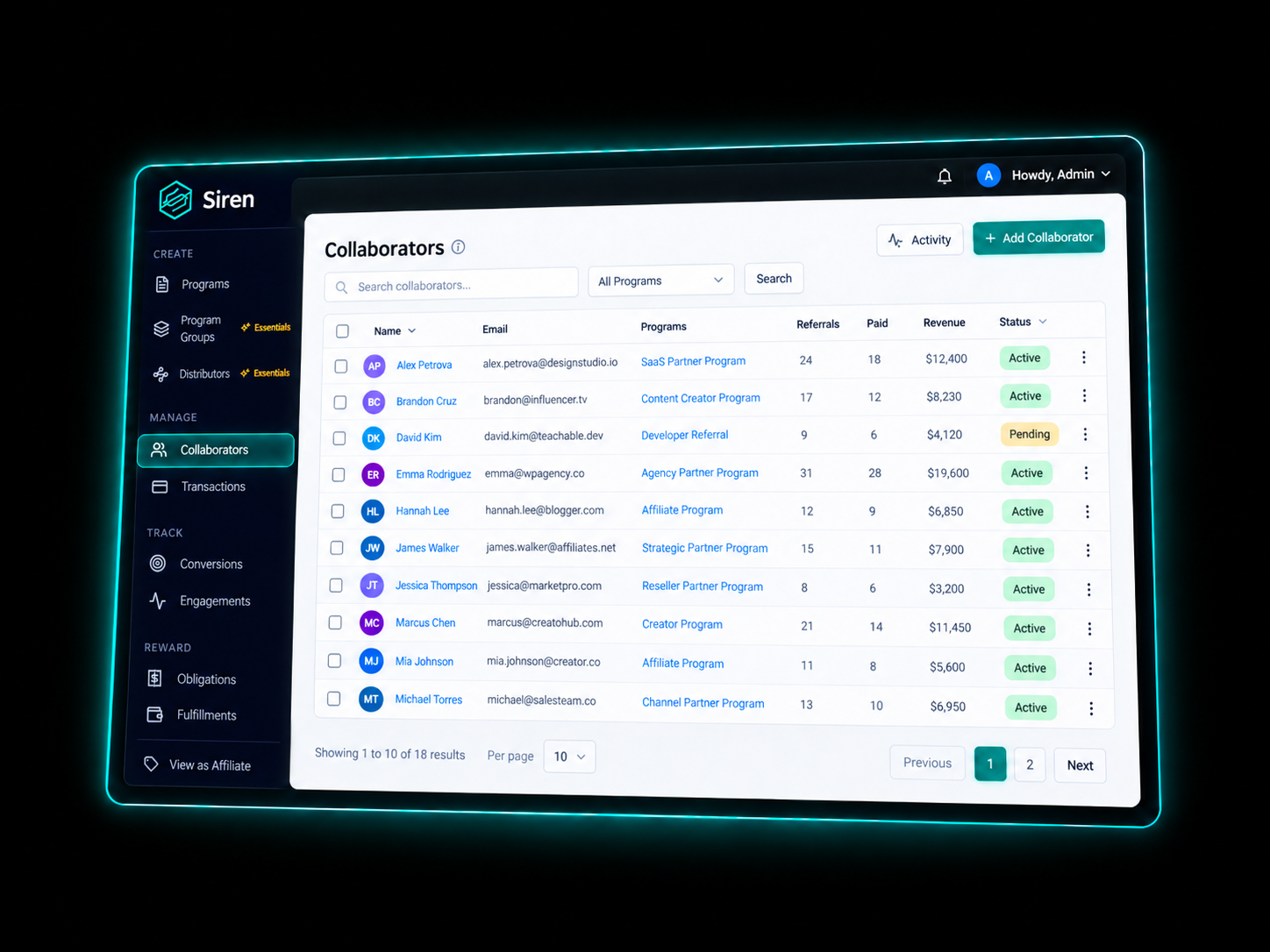
If you’re considering switching to Siren, you can prepare your new affiliate program without immediately shutting down your existing platform.
Siren provides several tools to support a gradual migration:
- Collaborator imports: Bring your existing affiliates into Siren Cloud using the CSV importer.
- Flexible commission structures: Recreate your existing reward rules using customizable programs and ready-to-use Recipes.
- Tracking and commission diagnostics: Verify attribution and understand why commissions are or aren’t generated.
- Affiliate communications: Configure notifications to support collaborator onboarding and ongoing communication.
- Performance analytics: Monitor program performance with Siren Analytics throughout the transition.
You can also request managed migration assistance, with the scope and cost determined by your program’s requirements.
For detailed instructions, available migration options, and platform-specific considerations, explore our complete guide to migrating your affiliate program to Siren.
Ready to explore your next affiliate platform?
Full Pro Access. No Credit Card Required.
Final Thoughts
A successful affiliate program migration comes down to careful planning and a gradual transition.
By taking the time to prepare, test, and migrate in phases, you can protect your existing revenue, maintain your affiliates’ trust, and build a stronger foundation for your program’s future growth.